
 CA
 NZ
 UK
 AU
 IND

 US

 Share
 X (Formerly Twitter)
 Whatsapp
 Facebook
 LinkedIn
 Telegram
 Email This Article
 Copy Link
 Summarize with AI
 Chat GPT
 Perplexity

Artificial intelligence is no longer a peripheral experiment inside Big Tech. It is now the primary driver of capital allocation. In 2026, the largest hyperscale technology companies — including Microsoft (NASDAQ:MSFT), Amazon (NASDAQ: AMZN), Alphabet (NASDAQ: GOOGL), and Meta (NASDAQ: META) — have outlined capital expenditure plans that collectively approach $650–$700 billion, with a substantial share directed toward AI infrastructure, data center expansion, advanced GPUs, and cloud computing capacity.
At the center of this structural shift in global technology spending stands Nvidia ($NVDA), the dominant supplier of AI accelerators and high-performance GPUs powering generative AI, large language models (LLMs), and enterprise AI workloads.
The Scale of AI CapEx in 2026: What the Hyperscalers Have Disclosed
Recent filings, earnings transcripts, and public guidance show a dramatic escalation in AI-related infrastructure spending:
- Amazon (NASDAQ: AMZN) has signaled approximately $200 billion in capital expenditure for 2026, driven largely by AWS cloud infrastructure, AI compute clusters, and next-generation data centers.
- Alphabet (NASDAQ: GOOGL) has guided toward roughly $175–$185 billion in capital spending, primarily for technical infrastructure, including servers and AI-optimized data centers supporting Google Cloud and DeepMind initiatives.
- Meta Platforms (NASDAQ: META) expects between $115–$135 billion in capital expenditures in 2026, with a strong focus on AI data centers, training clusters, and generative AI deployment.
- Microsoft (NASDAQ: MSFT) has already spent approximately $72 billion in the first half of its fiscal 2026 year. At this pace, full-year capital expenditure could exceed $140 billion, much of it allocated to Azure AI infrastructure and data center capacity.
Together, these four hyperscalers alone account for well over $600 billion in projected infrastructure investment, much of which is directly tied to artificial intelligence workloads.
Apple ($AAPL) and Tesla ($TSLA), while part of the “Magnificent Seven,” have comparatively smaller infrastructure capex footprints, with spending more diversified across hardware manufacturing, custom silicon, and autonomous systems rather than hyperscale AI cloud infrastructure.
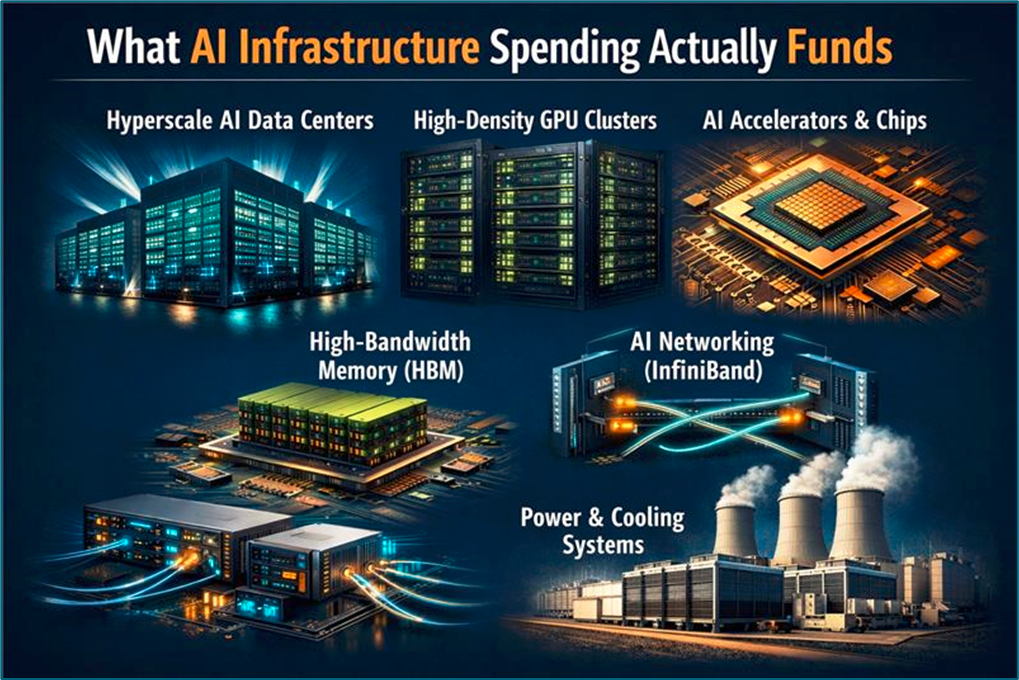
What AI Infrastructure Spending Actually Funds
AI capital expenditure differs materially from traditional IT spending. It includes:
- Hyperscale AI data centers
- High-density GPU clusters
- AI accelerators and semiconductor chips
- High-bandwidth memory (HBM)
- AI networking solutions (InfiniBand, high-speed interconnects)
- Power and cooling systems for high-compute environments
Training advanced large language models requires thousands of GPUs operating simultaneously. Inference workloads — the real-time deployment of AI systems — add further compute requirements. This shift dramatically increases demand for specialized semiconductor hardware.
Unlike prior semiconductor cycles tied to consumer electronics or PC refresh cycles, AI infrastructure spending reflects enterprise and cloud-driven structural demand.
Nvidia’s Role in the AI Semiconductor Ecosystem
Nvidia’s Data Center segment has become the core engine of its growth, as reflected in its most recent quarterly and annual filings. Its GPUs, including advanced architectures designed for AI training and inference, are widely deployed across hyperscale cloud providers.
Beyond hardware, Nvidia’s CUDA software ecosystem reinforces its position. Developers building AI models are deeply integrated into Nvidia’s programming framework, creating switching costs and ecosystem advantages.
In addition, Nvidia’s networking technologies — following its acquisition of Mellanox — position it not only as a chip supplier but as a provider of integrated AI infrastructure solutions.
Given the scale of hyperscaler capex and the compute intensity of AI workloads, Nvidia occupies a strategic position in the global semiconductor supply chain.
Structural AI Demand vs. Cyclical Semiconductor Growth
Historically, semiconductor demand fluctuated with consumer hardware cycles. AI infrastructure spending represents a structural shift:
- AI models continue growing in size and complexity
- Enterprises embed AI into workflows and automation systems
- Cloud providers compete on AI service capabilities
- Governments invest in sovereign AI computing capacity
This structural demand alters the capital intensity of the technology sector. Data centers are becoming AI-first rather than general-purpose compute hubs.
Competitive and Strategic Considerations
While Nvidia holds a dominant share of the AI accelerator market, competition is emerging. AMD has introduced AI-focused GPUs. Hyperscalers are developing custom AI chips. Semiconductor supply chains remain sensitive to geopolitical and manufacturing constraints.
Nevertheless, the magnitude of announced AI capital expenditure underscores the depth of demand for accelerated computing.
Conclusion: Nvidia and the AI Infrastructure Supercycle
With hyperscalers collectively committing up to $650–$700 billion in 2026 capital expenditures, much of it directed toward AI data centers and cloud infrastructure, artificial intelligence has become the defining investment theme of the technology sector.
Nvidia ($NVDA), as a leading supplier of AI GPUs and accelerated computing platforms, remains central to this infrastructure build-out. The company’s position reflects not only market share but ecosystem depth and technological specialization in AI acceleration.
The broader story is not solely about one firm, but about the transformation of global computing infrastructure. Artificial intelligence is reshaping capital allocation across the technology industry — and AI infrastructure has become the new foundation of digital competition.


 Nov 10, 2026





 Please wait processing your request...