
 CA
 NZ
 UK
 AU
 IND

 US

 Share
 X (Formerly Twitter)
 Whatsapp
 Facebook
 LinkedIn
 Telegram
 Email This Article
 Copy Link
 Summarize with AI
 Chat GPT
 Perplexity
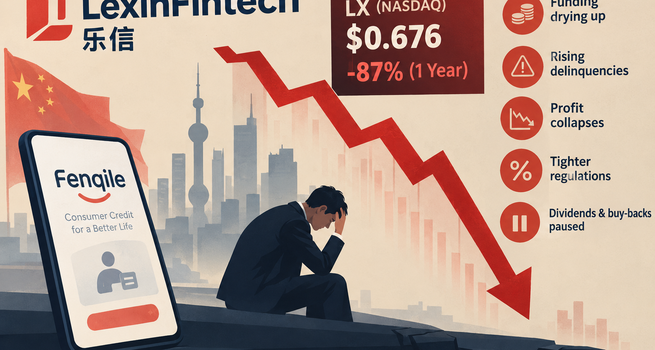
Key Highlights:
- LexinFintech Holdings Ltd (NASDAQ:LX) closed at $0.676 on October 5, 2026, near its 52-week low and about 88.6% below the 52-week high of $5.94.
- Second-quarter Net Income fell about 80% year on year to RMB 101 million.
- Management expects materially lower third-quarter originations, higher delinquencies and a possible net loss.
- The Dividend is now annual and tied to 30% of net income, and buy-backs are effectively paused.
- The company has given no full-year 2026 guidance, and no delisting order has been found.
Shares in the instalment lender have lost almost nine-tenths of their value. The company itself says the worst may not be over
Few things in finance are as unforgiving as a funding market that stops trusting its borrowers. In late June, risk events at several industry peers led the banks and other institutions that fund China's instalment-credit platforms to conclude, more or less simultaneously, that they would rather be elsewhere. The tap that feeds firms like LexinFintech Holdings Ltd (NASDAQ:LX) did not slow. It was shut. Lexin, which runs a consumer-credit platform called Fenqile, cut the loans it originates to protect its liquidity. On August 31st it told investors what that had done to the business. They have been selling ever since.
A rout in numbers
At the close on October 5th, LexinFintech (NASDAQ:LX) stood at $0.676, and it traded around $0.68 the next day. That is essentially its 52-week low. The 52-week high is $5.94. The distance between the two, $5.26, is a fall of roughly 88.6%. Depending on which data vendor one trusts, the one-year loss is between 86.6% and 87.1%. Simply Wall St shows 86.6%; another feed shows 87.1%. Macrotrends, working from a September 30th close of $0.72, put the same $5.94 peak at about 725% above the price then, which is the same drawdown stated the other way round.
Shorter windows are no kinder. The stock has lost about 23% in a month and about 63% in three. It opened the year at around $2.98, so it is down roughly 77% since January. The Market Capitalisation is near $112m. Analysts, rarely the first to spot trouble, have caught up: one cited cut took a price target from $4.38 to $1.20, citing weaker volumes, deteriorating asset quality and funding risk.
The collapse in the share price follows a collapse in earnings. Second-quarter net income fell by about 80% year on year, to RMB 101m, and net Revenue dropped sharply too. That would be bad enough as a one-off, but management went on to say it was not one. Originations in the third quarter, it warned, would fall materially. Loans overdue by 90 days or more would rise further, and collection rates would weaken. The firm said it may report a net loss, and it declined to give any guidance for the full year. A company that cannot say what 2026 will look like, with the year more than three-quarters gone, is telling you something about how little it can see.
Three squeezes at once
It is tempting to treat all this as panic, and some of it surely is. But Lexin's troubles are better understood as three squeezes arriving together.
The first is on volume. Lexin does not, for the most part, lend from its own pocket. It matches borrowers with banks and other funding partners, earns fees for doing so, and often guarantees part of the Credit risk. This is a clever model when funding is plentiful, because a modest balance-sheet can support a large Loan book. It is a fragile one when funders retreat, because the platform has no deep reservoir of its own to draw on. When the money pulled back, LexinFintech Holdings Ltd (NASDAQ:LX) had little choice but to lend less.
The second is on price. A new regulatory framework that took effect in late 2025, including caps on interest rates, has already compressed what lenders like Lexin can charge. Regulators in Beijing have spent years nudging consumer finance away from the high-margin, high-volume model that made it so profitable, and towards something tamer and more closely supervised. The official aim is to protect borrowers. The effect on the platforms is to shrink the Margin on each loan just as they write fewer of them.
The third is on credit quality, and it is the most worrying because it is the least within Lexin's control. The share of loans 90 days or more overdue edged up from 3.5% to 3.6%. That sounds trivial, and in isolation it is. But the more sensitive measure, loans overdue by a single day, rose by about 9.5% from the previous quarter. Early delinquencies are the canary in this particular mine, since they tend to precede the later, costlier ones. Provisions for contingent guarantee liabilities, the money set aside to cover borrowers who Fail to repay loans the company has promised to back, jumped.
Recovery is getting harder as well. Tighter rules on how lenders may chase late payers have curbed some of the more aggressive collection methods that were once routine in the business. Few would mourn them. But a lender that collects less must provision more, and provisions come straight out of profit. Less volume, lower rates and higher credit costs: it is hard to design a worse combination.
Shareholders pay
Companies reveal what they believe by what they do with cash. Lexin's board has moved its dividend from a semi-annual to an annual payment, tied from fiscal 2026 to 30% of net income. With net income collapsing, the dividend has in effect shrunk with it. Share buy-backs, once a favoured signal of confidence, have been effectively paused. Nobody issued a press release headlined "We are conserving cash". They did not need to.
None of this means that LexinFintech (NASDAQ:LX) is about to go bust. The company describes itself as adequately capitalised, and management has stressed its liquidity. Outside observers have noted that the losses it fears are largely provision-driven: accounting charges for loans that may sour, rather than cash that has already left the building. The distinction matters. A firm writing down future losses is in a different position from one that cannot pay its bills today.
Nor is there, as far as can be found, a current delisting order. There is, though, a louder background hum. Commentary and complaint posts allege cross-regional lending problems, a heavy Volume of customer complaints and disputes over collection. These are allegations, not findings, and they are not the same as a disclosed enforcement action. Yet in China's consumer-credit business, regulatory Goodwill is itself a form of capital, and it is not obviously growing.
Cheap for a reason
So is the stock a bargain? The temptation is to say so. A share that has lost nearly nine-tenths of its value looks, by definition, as if it is pricing in disaster. But a low price is not the same as a mispriced one. At $0.68, LexinFintech Holdings Ltd (NASDAQ:LX) trades at a discount for specific, identifiable risks: that funding stays scarce, that delinquencies keep rising, that profits do not return and that the promised payouts to shareholders stay deferred. The valuation is the market's estimate of those risks. It is not evidence that they have been resolved.
The deeper difficulty is that the trough has not been confirmed. Management itself says originations will fall further and credit quality will worsen. In such a setting, a cheap stock is more likely to get cheaper than to re-rate. The usual signs of a bottom are a stabilisation in funding supply, a levelling-off in early delinquencies and a return to guidance. Lexin currently offers none of the three.
That is the real lesson of the past four months. Platform lenders thrive on trust, between borrowers and lenders and between lenders and their funders. It accumulates slowly and is spent quickly. In June it was spent across the whole industry at once, and Lexin, which holds less of it in reserve than a bank would, is now paying the bill by instalments.
Disclosure: Figures are drawn from the company's August 31st, 2026 results and market-data vendors as of October 6th, 2026. This article is for information only and is not Investment advice.


 Nov 09, 2026





 Please wait processing your request...