
 CA
 NZ
 UK
 AU
 IND

 US

 Share
 X (Formerly Twitter)
 Whatsapp
 Facebook
 LinkedIn
 Telegram
 Email This Article
 Copy Link
 Summarize with AI
 Chat GPT
 Perplexity
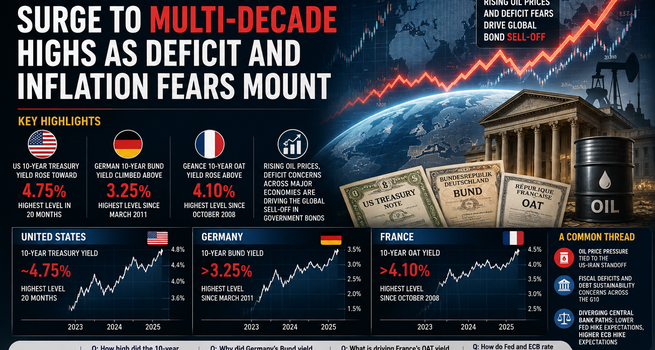
Key Highlights
- The 10-year US Treasury Yield rose toward 4.75%, its highest level in 20 months.
- Germany's 10-year Bund yield climbed above 3.25%, its highest since March 2011.
- France's 10-year OAT yield rose above 4.10%, its highest since October 2008.
- Rising oil prices tied to the US-Iran standoff, alongside Deficit concerns across major economies, are driving the global selloff in government bonds.
Global bond yields rallied on mounting concerns over massive government spending and persistent inflationary pressures. Long-term borrowing costs in the US, Germany, and France climbed to their highest levels in at least a decade, while Japanese yields hover close to all-time highs, underscoring how broadly this repricing has spread across the world's largest sovereign Debt markets rather than remaining confined to any single country.
US Treasuries: A 20-Month High
The yield on the 10-year US Treasury note rose toward 4.75% on Tuesday, the highest in 20 months, as surging Credit Supply and risks of entrenched Inflation extended the aversion to longer-maturity bonds. Corporate debt issuance in the US gained ground on the markets' forefront, with estimates pointing to $1.5 trillion in bonds issued by AI companies this year alone.
The surge in dollar-denominated fixed-income supply magnified ongoing concerns about accelerating deficit spending in the US and other G10 economies, raising estimates on the term premia demanded across bond markets worldwide. Meanwhile, oil prices rose further as President Trump signaled there was no rush to end the blockade against Iranian tankers in the Persian Gulf. Higher energy prices had already lifted underlying inflation this year, adding further pressure on Treasuries, as Fed Chairman Warsh stoked worries of inflation complacency after noting that a rate hike may not be his preferred tool against inflation.
Germany's Bund Yield: Highest Since 2011
Germany's 10-year Bund yield climbed above 3.25%, reaching its highest level since March 2011, as Government Bonds came under renewed selling pressure globally. The move was driven largely by fading hopes for a quick resolution to the Iran conflict, which pushed oil prices higher and revived concerns over persistent inflation. Broader concerns about fiscal sustainability in major economies, including France, Japan, the UK, and the US, also weighed on government debt markets.
Markets are increasingly pricing in a tighter path for European monetary policy, with the ECB deposit rate seen at 2.76% by March 2027, versus the current 2.25%, alongside more than a 90% probability of a September rate hike. That stands in contrast to the US, where softer economic indicators have reduced expectations for an imminent Fed rate hike, highlighting a growing divergence between the two central banks' expected policy paths even as long-term yields rise in both regions.
France's OAT Yield: Highest Since 2008
France's 10-year OAT yield rose above 4.10%, reaching its highest level since October 2008, amid the broader global fixed-income selloff. Rising oil prices, following the expiry of the US-Iran ceasefire and Tehran's threat to adopt a more aggressive military stance, have revived inflation concerns and contributed to higher borrowing costs across the board.
France, however, faces additional pressure from its own worsening fiscal position. Interest payments reached €34.5 billion in the first half of the year, 19% higher than a year earlier, while public debt is already around 118% of GDP. Even if the government meets its target of limiting the Budget Deficit to about 5% of GDP this year, debt is projected to climb further in the coming years. Softer US economic data have reduced expectations for near-term Federal Reserve tightening, a contrast to the increasingly hawkish expectations building for European monetary policy.
A Common Thread: Deficits, Oil, and Diverging Central Banks
Across all three markets, the same set of forces is compounding: renewed oil-price pressure tied to the unresolved US-Iran standoff, persistent worries about government deficits and debt sustainability across the G10, and a widening gap between how the Federal Reserve and the European Central Bank are expected to respond. In the US, softer data has pushed rate-hike expectations lower even as long-term yields climb, a divergence that echoes the pattern already playing out in the Treasury market. In Europe, by contrast, markets are pricing a meaningfully higher probability of ECB tightening, adding a distinct regional driver on top of the shared pressures from oil and fiscal concerns.
The scale of the moves, Germany at a 14-year high and France at levels not seen since the depths of the 2008 financial crisis, illustrates how quickly term premia can reprice when multiple pressures arrive at once. Elevated debt issuance from AI-related corporate borrowing, sovereign deficit spending, and a geopolitical shock to energy prices rarely align in the same window, and the combination now appears to be pushing long-term borrowing costs higher across nearly every major developed Bond Market simultaneously.


 Nov 18, 2026





 Please wait processing your request...