
 CA
 NZ
 UK
 AU
 IND

 US

 Share
 X (Formerly Twitter)
 Whatsapp
 Facebook
 LinkedIn
 Telegram
 Email This Article
 Copy Link
 Summarize with AI
 Chat GPT
 Perplexity
Key Highlights
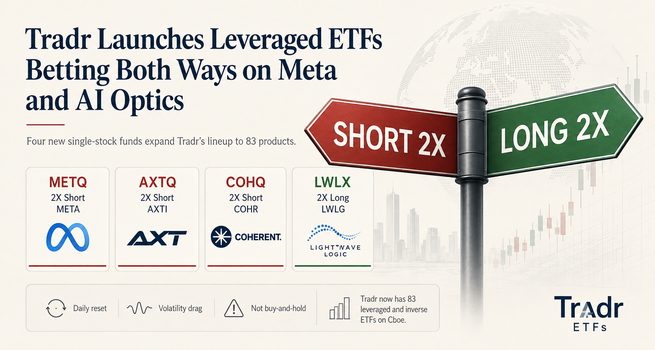
- Tradr ETFs has listed four new single-stock leveraged ETFs on Cboe, adding short exposure on Meta Platforms and long exposure on Lightwave Logic.
- The launch expands Tradr's product suite to 83 leveraged and inverse ETFs, deepening its footprint in single-stock trading instruments.
- Two of the new funds pair with existing products to give traders both long and short exposure on the same underlying stock.
- The products carry daily reset mechanics that make their risk profile fundamentally different from simply holding the underlying shares.
The New Listings
Tradr ETFs has introduced four new Exchange-traded funds on Cboe, extending its lineup of single-stock leveraged products into new territory. Three of the funds offer short, or inverse, exposure: the Tradr 2X Short META Daily ETF (Cboe: METQ), tracking Meta Platforms, Inc. (NASDAQ:META); the Tradr 2X Short AXTI Daily ETF (Cboe: AXTQ), tracking AXT, Inc. (NASDAQ:AXTI); and the Tradr 2X Short COHR Daily ETF (Cboe: COHQ), tracking Coherent Corp. (NYSE:COHR). A fourth fund, the Tradr 2X Long LWLG Daily ETF (Cboe: LWLX), offers long exposure to Lightwave Logic, Inc. (NASDAQ:LWLG).
Each fund seeks to deliver twice the daily performance of its underlying stock, in the direction specified. The short funds aim for negative 200 percent of daily performance, while the long fund aims for positive 200 percent. These are single-stock products, meaning each ETF tracks one company rather than a basket or index, a structure that has grown more common in the exchange-traded fund industry over the past several years.
Understanding Daily Reset Exposure
A "2x daily" ETF does not deliver two times the return of its underlying stock over a week, a month, or a year. Instead, it resets its exposure at the end of every trading day, aiming only to capture double the stock's performance for that single session.
This distinction matters because of how compounding interacts with volatility. When a stock's price moves up and down repeatedly over multiple sessions, a fund that resets daily can produce a cumulative return that diverges meaningfully from what a simple doubling of the stock's longer-term return would suggest.
Why Longer Holding Periods Change the Math
This effect, often called Volatility drag, tends to erode returns in choppy or sideways markets, even when the underlying stock is roughly flat over the period. The divergence becomes more pronounced the longer the Holding Period and the more volatile the underlying stock.
Long Versus Short Mechanics
Long and short versions work as mirror images of each other. A long fund such as LWLX gains value when Lightwave Logic rises and loses value when it falls, at roughly twice the daily magnitude. A short fund such as METQ does the opposite, gaining value when Meta Platforms falls and losing value when it rises. Shares of these ETFs trade on an exchange throughout the day at market prices, similar to any other ETF, rather than being redeemed individually by the fund at a fixed net asset value.
The Strategic Rationale Behind the Pairings
Tradr's stated rationale centers on giving traders tools to express both bullish and bearish views on stocks already covered by its existing lineup, alongside exposure to a newer thematic name. AXTQ complements the Tradr 2X Long AXTI Daily ETF, listed earlier in the year, giving traders the ability to take either side of AXT, Inc. shares. COHQ performs a similar function alongside the Tradr 2X Long COHR Daily ETF, tracking Coherent Corp. According to the firm, Demand from active traders to express bearish views on both names prompted the short-side listings.
Meta Joins the Mega-Cap Short Roster
METQ extends Tradr's existing roster of short exposure on large technology companies, which already includes inverse products tracking Amazon.com, Inc., NVIDIA Corporation, and Tesla, Inc. Meta Platforms joins that group as one of the most actively traded mega-cap technology stocks, offering traders a vehicle to express short-term bearish positioning without using Margin or options.
The AI Optics Angle Behind LWLG
Lightwave Logic represents a different category. The company operates in optical materials, a segment tied to the broader buildout of artificial intelligence infrastructure and data transmission networks. Tradr characterized it as a smaller-capitalization name gaining attention as investors look further down the Supply chain supporting AI-related connectivity.
A Broader Industry Pattern
The launch reflects a broader pattern in the exchange-traded fund industry, where issuers have steadily expanded single-stock leveraged and inverse products beyond mega-cap names into mid-cap and thematic names. Tradr's growth to 83 total leveraged ETFs illustrates the scale this segment has reached. The firm has also increasingly paired long and short versions of the same underlying stock, a structural choice that lets traders position in either direction using the same product family rather than seeking separate instruments or derivatives.
This pairing approach, seen now with AXTI and COHR, signals that issuers view two-way tactical demand, rather than one-directional conviction alone, as a durable driver of flows into single-stock leveraged products. Whether that demand persists across a broader set of underlying names remains an open question tied to trading volumes and volatility levels across the technology sector.
Risk Considerations
Leveraged and inverse ETFs carry risks distinct from those of holding the underlying shares directly. Because these funds pursue daily leveraged objectives, their performance over periods longer than a single trading day can differ significantly from twice the underlying stock's return over that same period, particularly in volatile or range-bound markets. The magnitude of this divergence depends on both the path of the underlying stock's price and its volatility over the holding period.
The Total-Loss Scenario
Leverage also magnifies downside risk. In a scenario where the underlying stock moves more than 50 percent against the fund's position within a single trading day, an investor holding a 2x fund could lose the entirety of their investment, since the fund does not manage its exposure to cap potential losses at a fixed percentage of net asset value. These products are structured for short-term, actively managed positions rather than buy-and-hold strategies, and their suitability depends on an investor's ability to monitor and manage exposure closely. As with any leveraged instrument, potential losses must be weighed against potential gains, and no outcome is assured.

 Nov 03, 2026





 Please wait processing your request...