
 AU
AU
 UK
UK
 CA
CA
 NZ
NZ
 IND
IND

 US
US

 Share
Share
 X (Formerly Twitter)
 Whatsapp
 Facebook
 LinkedIn
 Telegram
 Email This Article
 Copy Link
 Summarize with AI
 Chat GPT
 Perplexity
Key Highlights
- The fee gap is a wealth An investor choosing a 0.03% expense ratio fund over a 1.0% actively managed fund on a $100,000 investment could accumulate over $230,000 more over 30 years — purely from the compounding effect of lower costs.
- One fund can do the job. VTSAX covers approximately 3,500–4,000 US stocks across every market cap For most long-term investors, a single consistent position in a total-market index fund will outperform the majority of multi-fund, actively managed strategies over time.
- Gold's rally has macro roots — not permanent ones. GLDIX's strong recent returns were driven by elevated inflation, geopolitical risk, and central bank gold accumulation. These are cyclical tailwinds, not structural ones — making position sizing (5–10% of portfolio) critical for anyone adding gold equity
- Zero fees are real. Fidelity's FNILX carries a genuine 0.00% expense ratio — not a promotional waiver, but a structurally sustainable product built around Fidelity's proprietary index, which avoids S&P licensing costs entirely.
For decades, the debate at the heart of American investing has been deceptively simple: should you pay a professional to pick stocks, or simply buy the market and go home? In 2026, that debate has a clearer answer than ever before. The data increasingly favours low-cost, broadly diversified index funds as the foundation of long-term wealth building — and the funds that have consistently dominated performance rankings reflect precisely that reality.
Yet the story is not entirely black and white. Specialized sector funds — particularly those with exposure to gold, commodities, and technology — have delivered returns in recent periods that no broad market index could match. For investors with the stomach for volatility and a clear understanding of what they own, selective sector exposure can add meaningful alpha to a core portfolio.
This guide covers both worlds: the reliable, low-cost index funds that form the backbone of millions of American retirement accounts, and the higher-octane sectoral funds that have caught the attention of performance-chasing investors in early 2026. More importantly, it explains what each fund actually does, who it is appropriate for, and what the performance data really means when you strip away the marketing.
Why Mutual Funds Still Matter in the Age of ETFs
AI Powered Image
Before diving into specific funds, it is worth addressing a question that increasingly surfaces among younger investors: in a world of commission-free ETF trading, real-time pricing, and fractional shares, why do mutual funds still attract trillions of dollars in assets?
The answer lies in the structural advantages that mutual funds retain over their exchange-traded cousins — particularly for long-term, retirement-focused investors. Mutual funds allow automatic investment of any dollar amount, making systematic monthly contributions seamless. They are the default vehicle inside most employer-sponsored 401(k) plans, meaning millions of Americans already own them whether they know it or not. And for the specific funds covered in this article — the Fidelity and Vanguard flagship index products — the cost difference between the mutual fund and ETF versions has narrowed to the point where it is essentially irrelevant for most investors.
The more important point is this: the fund wrapper matters far less than the underlying investment strategy and cost structure. A zero-fee index fund tracking the S&P 500 in mutual fund form is functionally equivalent to an ETF doing the same job. The question is always: what are you buying, at what cost, and does it fit your investment objective?
The Index Fund Titans: Building Wealth the Low-Cost Way
Fidelity 500 Index Fund (FXAIX): The Gold Standard of Simplicity
AI Powered Image
If there is a single mutual fund that exemplifies the philosophy of evidence-based investing, it is FXAIX. Fidelity's 500 Index Fund tracks the S&P 500 — the 500 largest publicly traded companies in the United States — at an expense ratio that has been driven to near zero through years of competitive pressure between Fidelity and Vanguard.
The S&P 500 itself is not simply a list of America's 500 biggest companies. It is a carefully constructed index weighted by market capitalisation, regularly rebalanced, and broadly considered the most representative barometer of US large-cap equity performance. When financial commentators say "the market is up today," they almost always mean the S&P 500 is up.
FXAIX's performance track record needs little embellishment — it is, by design, the performance of the S&P 500 itself, minus a microscopic management fee. Over rolling five-year periods, the S&P 500 has historically delivered annualised returns in the range of 10–15% during periods of economic expansion, with shorter periods of sharp decline during recessions and market corrections. In early 2026, with the index navigating a complex macro environment of elevated interest rates, geopolitical uncertainty from the Middle East, and ongoing tariff volatility, FXAIX continues to reflect the aggregate earnings power of America's most valuable corporations.
The fund is appropriate for virtually every type of long-term investor. Its low fees, broad diversification across sectors, and the liquidity of the underlying index make it an almost universal recommendation as a core portfolio holding. For investors just beginning their journey, for those building a 401(k), or for those who simply want reliable market exposure without the complexity of active stock selection, FXAIX is the starting point.
Key Facts: Tracks S&P 500 | Ultra-low expense ratio | Large-cap US equity exposure | Ideal for core long-term portfolios
Vanguard 500 Index Fund Admiral Shares (VFIAX): Vanguard's Flagship S&P 500 Product
 AI Powered Image
VFIAX is, in most meaningful respects, the Vanguard equivalent of FXAIX — both track the S&P 500, both carry near-zero expense ratios, and both have delivered essentially identical returns to their respective investors over any meaningful time period. The differences are institutional rather than financial: VFIAX is a Vanguard product, and Vanguard's unique ownership structure — in which the funds own the company, which in turn means investors own the company — has long been cited as a structural alignment of interests between manager and shareholder that has no real parallel in the fund industry.
Vanguard founder John Bogle's insight — that the average actively managed fund cannot consistently beat a low-cost index fund after fees — has proven so durable that it is now considered one of the closest things to a financial law that the investment industry possesses. VFIAX is the most direct institutional expression of that insight.
For investors already within the Vanguard ecosystem — using Vanguard's brokerage platform, holding other Vanguard funds, or participating in a Vanguard-administered retirement plan — VFIAX is the natural S&P 500 vehicle. For those outside that ecosystem, the performance difference between VFIAX and FXAIX is negligible, and the choice comes down to platform preference and the specific fee structures of the accounts in question.
Key Facts: Vanguard's flagship S&P 500 index fund | Admiral Shares minimum investment required | Near-zero fees | Structurally aligned ownership model
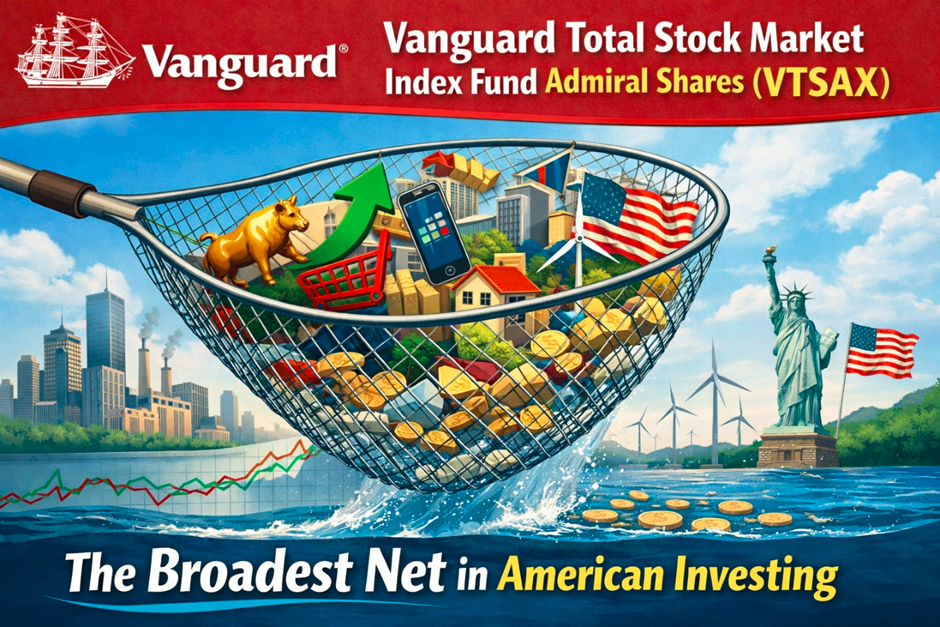
Vanguard Total Stock Market Index Fund Admiral Shares (VTSAX): The Broadest Net in American Investing
AI Powered Image
Where FXAIX and VFIAX capture the 500 largest US companies, VTSAX goes further — it tracks the entire investable US equity market, including large-cap, mid-cap, small-cap, and micro-cap stocks across all sectors. In practical terms, this means owning a piece of approximately 3,500 to 4,000 publicly traded US companies rather than 500.
The investment case for VTSAX over a pure S&P 500 fund rests on the theory of total market diversification. The additional mid-cap and small-cap exposure in VTSAX has historically contributed incremental return over very long periods, as smaller companies — while more volatile — have tended to grow faster than their large-cap counterparts through complete economic cycles.
In the near term, however, VTSAX and S&P 500 index funds tend to move in close tandem. The S&P 500 companies account for approximately 80% of the total US equity market by capitalisation, meaning the largest 500 companies dominate the index's performance regardless of what smaller stocks are doing. The practical difference between VTSAX and VFIAX for most investors is one of philosophy rather than near-term return differentiation.
VTSAX has become the single most frequently recommended fund on personal finance communities and financial planning websites in the United States — a reflection of both its simplicity and its all-market exposure. For investors who want to own "everything" with a single fund and never revisit the decision, VTSAX is the most complete single-fund expression of passive US equity investing available.
Key Facts: Covers entire US equity market (~3,500–4,000 stocks) | Includes large, mid, small, and micro-cap | Near-zero expense ratio | Most broadly diversified single US equity fund available
Fidelity ZERO Large Cap Index (FNILX): Zero Fees, No Compromise
FNILX represents Fidelity's most aggressive move in the long-running fee war with Vanguard — a mutual fund with a 0.00% expense ratio. Zero. Not 0.03%. Not 0.01%. Zero.
The fund tracks Fidelity's own proprietary large-cap index — not the S&P 500 specifically, but a comparable universe of the largest US stocks — which is how Fidelity is able to eliminate licensing fees that would otherwise make a zero-expense-ratio product economically unviable. The underlying index is similar enough to the S&P 500 that performance differences are negligible over time.
For cost-conscious investors — particularly those in the early stages of wealth building, where fees represent the largest proportional drag on long-term compounding — FNILX is a genuinely remarkable product. The absence of any annual fee means that 100% of investment returns stay with the investor, compounding year after year without any management cost erosion.
The catch, if it can be called that, is that FNILX is only available through Fidelity's own platforms. Investors using other brokerages will not find it in their fund menus. But for Fidelity account holders — including the millions of Americans with Fidelity-administered workplace retirement plans — FNILX is the lowest-cost large-cap equity exposure available anywhere in the mutual fund universe.
Key Facts: 0.00% expense ratio — industry's lowest | Available exclusively through Fidelity platforms | Tracks Fidelity's proprietary large-cap index | Ideal for cost-maximizing long-term investors
Shelton NASDAQ-100 Index Direct (NASDX): Technology and Growth at Index Cost
NASDX tracks the NASDAQ-100 — an index of the 100 largest non-financial companies listed on the NASDAQ exchange, heavily weighted toward technology, consumer internet, and high-growth sectors. The index includes the companies that have defined the modern economy: Apple, Microsoft, Nvidia, Alphabet, Amazon, Meta, and their peers.
The investment case for NASDX relative to a broad market index fund is essentially a bet on the continued dominance of technology and innovation-driven growth in the US economy. The NASDAQ-100 has significantly outperformed the S&P 500 over the past decade — a period during which technology companies grew from important components of the economy to its defining force.
The flip side of this outperformance is concentration risk. The NASDAQ-100's top ten holdings typically account for over 50% of the index's total weight, meaning the fund's fortunes are heavily tied to a small number of very large technology companies. In periods of technology sector weakness — as seen during 2022's rate-driven growth stock selloff — the NASDAQ-100 declined significantly more than the broader S&P 500.
For investors with a long time horizon who are comfortable with above-average volatility in exchange for above-average growth potential, NASDX provides cost-efficient access to the technology leadership theme without requiring individual stock selection.
Key Facts: Tracks NASDAQ-100 | Concentrated technology and growth exposure | Higher volatility than broad market index | Strong historical long-term returns | Not suitable as a sole portfolio holding
The Specialist Category: Higher Risk, Higher Potential Reward
Gabelli Gold Fund I (GLDIX): Inflation Hedge, Crisis Insurance, and Pure Gold Equity Exposure
GLDIX occupies a fundamentally different category from the index funds discussed above. It is an actively managed fund investing primarily in gold mining companies and gold-related equities — a sector that behaves in ways almost entirely disconnected from the broader US stock market.
The fund's strong 3-year performance track record reflects the gold sector's powerful rally during a period of elevated inflation, geopolitical uncertainty, rising conflict risk in the Middle East, and investor demand for real asset protection. Gold mining equities — the primary holdings of GLDIX — provide leveraged exposure to the gold price: when gold rises, mining company profits tend to rise faster, amplifying returns for investors in funds like GLDIX.
In early 2026, the conditions that have driven gold's outperformance — persistent inflation, war-risk premiums in energy markets, central bank gold accumulation, and uncertainty around US trade and fiscal policy — remain substantially intact. GLDIX has benefited from all of these tailwinds simultaneously.
However, investors approaching GLDIX purely on the basis of recent returns should understand what they are buying. Gold equities are among the most volatile asset classes in the investable universe. They can decline sharply and rapidly when gold prices fall, when mining costs rise, or when the macro environment shifts in ways that reduce demand for safe-haven assets. The same factors that produced strong recent returns can reverse with equal speed.
The appropriate role for GLDIX in a diversified portfolio is as an inflation hedge and crisis-risk buffer — typically 5 to 10% of a total portfolio, providing a counterweight to equity and bond holdings during periods of market stress. It is not a core holding and it is not appropriate for investors who cannot tolerate significant short-term losses in exchange for the portfolio protection it provides in specific macro environments.
Key Facts: Actively managed gold equity fund | High 3-year returns driven by gold sector tailwinds | Significantly above-average volatility | Appropriate as a portfolio hedge, not a core holding | Performance is highly sensitive to gold price direction
How to Choose: A Framework for Every Type of Investor
The range of funds covered in this article spans the full spectrum from maximum simplicity to high-conviction sector concentration. The right choice depends on three questions that every investor must honestly answer.
First, what is your time horizon? Investors with more than ten years before they need to access their money can tolerate the short-term volatility of equity-heavy and sector-specific funds. Those within five years of retirement need meaningfully more caution — the sequence-of-returns risk at that stage makes capital preservation as important as growth.
Second, how much complexity do you want? For most retail investors, the honest answer is very little. A single holding in VTSAX or FXAIX, consistently contributed to over decades, will outperform the majority of actively managed funds and most multi-fund portfolios. The evidence for this is overwhelming and spans every market condition over the past half-century. Complexity does not automatically generate superior returns — it generates superior fees for the institutions that create it.
Third, do you have a specific need that a core index fund does not address? If the answer is inflation protection, GLDIX or a similar commodity-equity fund may have a role. If the answer is technology growth tilted above the market rate, NASDX provides that. If the answer is simply the broadest possible US equity exposure at the lowest possible cost, VTSAX is the answer. The fund selection conversation ends when you can answer all three questions with clarity and honesty.
The Expense Ratio Compounding Effect: Why Fees Matter More Than Most Investors Realise
One element of mutual fund analysis that is consistently underestimated by retail investors is the long-term compounding impact of expense ratios. Consider a simple illustration: an investor placing $100,000 in a fund returning 8% annually before fees over 30 years. In a fund charging 1.0% annually — the approximate average for actively managed US equity funds — the ending value is approximately $761,000. In a fund charging 0.03% — the approximate level of FXAIX or VFIAX — the ending value rises to approximately $993,000. The fee difference alone accounts for over $230,000 in terminal wealth from a single $100,000 investment.
This is why the zero-fee FNILX is not merely a marketing gimmick — for long-term investors, the elimination of annual management costs has a mathematically significant impact on wealth accumulation that grows larger with every additional year of investment.
Conclusion: The Case for Starting Simple and Staying Disciplined
The top-performing US mutual funds of early 2026 tell a consistent story. At their core, the best long-term performers are low-cost, broadly diversified index funds — FXAIX, VFIAX, VTSAX, and FNILX — that give investors the market's return rather than the uncertainty of attempting to beat it. Surrounding that core, specialist funds like NASDX and GLDIX offer additional exposures that, used appropriately and sized correctly, can enhance a portfolio's risk-adjusted return profile.
The temptation to chase the highest recent returns — invariably concentrated in whichever sector happened to benefit from the most recent macro event — is the single most reliable destroyer of long-term investor wealth. Gold funds outperform when inflation is high and crises multiply. Technology funds outperform when growth expectations are expansive and rates are low. Neither condition persists indefinitely.
The investors who consistently accumulate the most wealth over time are not those who identified the best-performing fund of the past three years. They are those who selected a low-cost, diversified core portfolio, invested regularly regardless of market conditions, kept fees to an absolute minimum, and resisted the urge to act on short-term noise. In 2026, as in every prior year, that lesson has not changed.


 Jun 24, 2026




 Please wait processing your request...