
 AU
AU
 UK
UK
 CA
CA
 NZ
NZ
 IND
IND

 US
US

 Share
Share
 X (Formerly Twitter)
 Whatsapp
 Facebook
 LinkedIn
 Telegram
 Email This Article
 Copy Link
 Summarize with AI
 Chat GPT
 Perplexity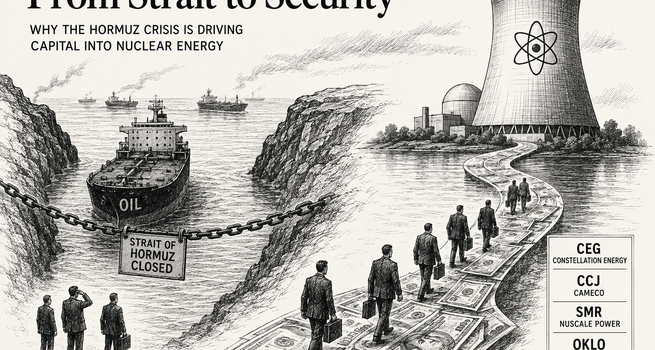
The Strait of Hormuz closure has triggered the largest energy security crisis since the 1970s. Nuclear energy is no longer a climate argument. It is a survival one. CEG, CCJ, SMR, and OKLO are the companies to watch.
Key Highlights
- The IEA has declared the current crisis the largest energy security shock in recorded history, directly comparing its structural impact to the 1970s oil shocks.
- Global nuclear Investment exceeds $80 billion per year with nearly 80 GW now under active construction.
- Morgan Stanley raises 30-year nuclear investment forecast by 47% to $2.2 trillion through 2050.
- AI-driven electricity Demand is locking in long-term nuclear power contracts with the world's largest technology companies.
- SMRs remain pre-commercial and nuclear's $81 per MWh levelized cost runs nearly three times higher than onshore wind.
A Structural Break, Not a Cyclical Reaction
Two crises in four years have settled a debate that climate policy could not. Russia's 2022 invasion of Ukraine exposed Europe's dependence on piped Natural Gas. The 2026 Iran war, initiated on February 28, has done something more severe: it has effectively closed the Strait of Hormuz, a corridor through which nearly one-fifth of global oil trade ordinarily moves.
The International Energy Agency, in its 2026 World Energy Investment report, did not soften its assessment. IEA Executive Director Fatih Birol described the situation as the largest energy security crisis the world has ever faced, drawing direct structural parallels to the 1970s oil shocks that permanently reordered global energy markets. That is not language the IEA uses lightly, and Capital-markets/">Capital Markets are responding accordingly.
Global energy investment is projected to reach $3.4 trillion in 2026. Of that total, approximately $2.2 trillion is flowing toward electricity infrastructure, grids, storage, renewables, nuclear, and energy efficiency. Nuclear's annual share now exceeds $80 billion, with close to 80 GW of new capacity under construction across 15 countries. The trajectory is upward.
Two Drivers, Not One
The first version of the nuclear investment thesis rested on climate commitments. That argument was real but slow-moving. The current thesis rests on two structural pillars simultaneously, and that combination is materially different.
The first is energy security. Countries that depend on imported fossil fuels through contested sea lanes now face an arithmetic problem that renewables alone cannot solve quickly enough. Nuclear provides dispatchable baseload power with fuel that can be stored onsite for years, entirely insulated from Strait of Hormuz shipping disruptions or LNG spot market Volatility.
The second driver is artificial intelligence. U.S. electricity consumption has hit consecutive record highs, and the Data Center buildout is expected to push demand further in 2026 and 2027. Technology companies need large volumes of firm, carbon-free power under long-term contracts. That demand profile fits nuclear precisely, and the private sector has moved.
Constellation Energy (Nasdaq:CEG), which operates the largest nuclear fleet in the United States at 22 GW of capacity, signed a 20-year power purchase agreement with Microsoft for power from its Illinois Clinton Facility. Meta Platforms (NASDAQ:META) followed with a 1.1 GW agreement with the same operator. Amazon (NASDAQ:AMZN) locked in 1.9 GW from Talen Energy (NASDAQ:TLN). Google reached a separate agreement with NextEra Energy (NYSE:NEE) to restart the previously decommissioned Duane Arnold plant in Iowa. These are decade-long infrastructure commitments made by some of the most analytically rigorous capital allocators in the world.
Morgan Stanley has taken note. The firm raised its nuclear investment forecast to $2.2 trillion through 2050, projecting that global nuclear capacity could more than double from 398 GW today to 860 GW by 2050. Bank of America has framed the broader opportunity at $10 trillion.
The SMR Question
Small modular reactors are the sector's most discussed growth vector, and also its most consequential source of execution risk. They promise faster build times, lower upfront capital, and factory-based Manufacturing Economics. The IEA estimates their payback period at roughly half the 20- to 30-year timeline typical of large reactors.
NuScale Power (NYSE:SMR) holds the only design certification from the U.S. Nuclear Regulatory Commission and is planning up to 6 GW of deployment across the Tennessee Valley Authority's service region. Oklo (NYSE:OKLO) is targeting data center and industrial customers with microreactors. GE Vernova (NYSE:GEV), in a joint venture with Hitachi, is advancing the BWRX-300, a 300-megawatt boiling water design with established engineering lineage.
The gap between commercial intent and operational reality remains significant. Most planned SMR deployments will not come online before 2030. Neither NuScale nor Oklo currently generates Revenue from reactor operations, and both are absorbing ongoing losses. The transition from regulatory approval to commissioned capacity is where nuclear projects historically encounter their largest cost and schedule surprises.
The Uranium Supply Chain Under Pressure
The reactor buildout depends on a fuel supply chain that has been structurally underinvested for over a decade. Uranium spot prices have moved from the low $20s per pound a decade ago to a range of $75 to $86 per pound currently, and demand is expected to outstrip supply by 2030 according to Cameco's own market assessments. The supply outlook has been further complicated by geopolitical tensions, including the Russia-Ukraine war and recurring U.S.-Iran confrontations, which have heightened concerns about energy security and accelerated Western efforts to secure domestic uranium, conversion, and enrichment capacity.
Cameco, which has committed to delivering approximately 28 million pounds per year through 2030 under finalized contracts, is among the clearest beneficiaries of this structural tightening.
On the enrichment side, Centrus Energy (NYSE:LEU) remains the only U.S.-licensed producer of high-assay low-enriched uranium, the advanced fuel variant required by next-generation reactor designs. Component manufacturing is anchored by BWX Technologies (NYSE:BWXT), which serves the full spectrum of reactor programs from existing large plants to SMR development.
The Risk the Thesis Cannot Dismiss
Nuclear's cost structure is the honest counterargument to its strategic appeal. The EIA estimates a levelized cost of electricity for new nuclear capacity entering service in 2030 at $81.45 per MWh, compared to $29.58 for onshore wind and $31.86 for Utility-scale solar. That gap does not close simply because geopolitical urgency increases.
There is also a scenario risk that the current thesis underweights. If ceasefire negotiations between the U.S. and Iran produce a durable agreement and the Strait of Hormuz reopens, the acute energy security premium driving nuclear urgency could moderate. Nuclear's long-duration investment thesis survives that scenario on the back of AI demand and decarbonization commitments. But the pace of capital deployment and the valuation multiples currently assigned to sector names may not.
Regulatory timelines, construction cost overruns, and uranium price volatility are known risks. The subtler risk is that the crisis-driven urgency now accelerating investment decisions creates a pipeline of projects that cannot all be financed and built efficiently at the same time. Nuclear's history contains more examples of that dynamic than its advocates generally acknowledge.
The Verdict
The structural case for nuclear investment is the strongest it has been since the 1970s, and for reasons that are likely to persist beyond the current crisis. The convergence of energy security imperatives, AI-driven electricity demand, institutional capital commitment, and bipartisan policy support in the United States represents a different investment environment than existed even two years ago.
Whether that structural shift translates into returns depends on execution at the project level and discipline at the capital allocation level. The $80 billion flowing annually into the sector is the beginning of a reallocation, not its conclusion. Where it ends depends less on declared intentions and more on whether the industry can deliver capacity on time and at a cost that does not undermine its own economic rationale.


 Jun 29, 2026




 Please wait processing your request...