
 CA
 NZ
 UK
 AU
 IND

 US

 Share
 X (Formerly Twitter)
 Whatsapp
 Facebook
 LinkedIn
 Telegram
 Email This Article
 Copy Link
 Summarize with AI
 Chat GPT
 Perplexity
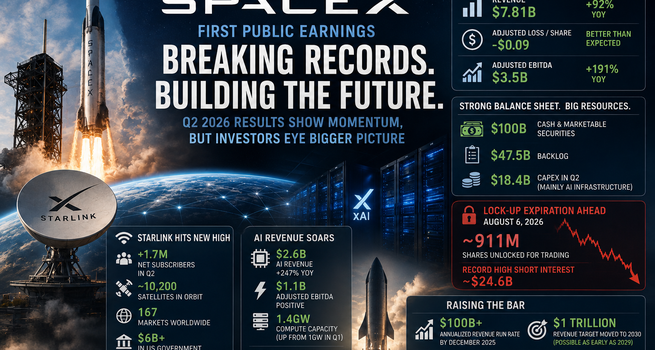
SpaceX's first quarterly earnings report as a publicly listed company delivered exactly the kind of contradiction that defines companies attempting to reshape industries. Revenue surged far beyond expectations, profitability improved dramatically, and management raised long-term guidance. Yet the stock reversed its initial rally as investors focused on continued heavy capital spending, AI operating losses, and a looming insider lock-up expiration.
The results highlight an important reality: companies building entirely new infrastructure rarely optimize for today's earnings. They optimize for tomorrow's capacity.
Key Highlights
- Q2 revenue reached USD 7.81 billion, up 92% year over year, beating Wall Street expectations of approximately USD 6.93 billion.
- Adjusted loss narrowed to USD 0.09 per share, significantly better than the expected USD 0.23-0.24 loss, while adjusted EBITDA surged 191% to USD 3.5 billion.
- Starlink added a record 1.7 million net subscribers, bringing the network to approximately 10,200 satellites across 167 markets, while enterprise and government revenue jumped 108% year over year.
- AI revenue climbed 247% year over year to USD 2.6 billion, with adjusted EBITDA turning positive at USD 1.1 billion, although the segment still posted an operating loss.
- SpaceX ended the quarter with nearly USD 100 billion in cash and marketable securities after its historic IPO and subsequent bond offering while maintaining an aggressive investment pace with USD 18.4 billion in quarterly capital expenditure.
- Management accelerated its long-term outlook, targeting a USD 100 billion annualized revenue run rate by December 2025 and moving its USD 1 trillion annual revenue target to 2030, one year earlier than previously expected.
Markets often reward predictable businesses. SpaceX is attempting something entirely different.
The company reported USD 7.81 billion in second-quarter revenue, representing 92% year-over-year growth and comfortably exceeding analyst expectations. The adjusted loss narrowed to only USD 0.09 per share, while adjusted EBITDA nearly tripled to USD 3.5 billion, demonstrating that operational leverage is beginning to emerge despite unprecedented investment levels.
Initially, investors applauded the results.
Then reality returned.
After-hours gains faded as attention shifted toward the company's continued AI operating losses, massive capital spending programme, and the first insider lock-up expiration scheduled for August 6, when approximately 911 million shares become eligible for trading. Combined with an estimated USD 24.6 billion in short interest, the earnings report now sits at the centre of one of the most closely watched events in the technology sector.
The strongest evidence that SpaceX's business model is maturing came from Starlink.
The satellite broadband network added 1.7 million net subscribers during the quarter, exceeding Q1's already impressive performance. The constellation now consists of roughly 10,200 satellites serving customers across 167 countries and markets.
Equally important, average revenue per user remained stable at approximately USD 66 per month, suggesting subscriber growth is not coming at the expense of pricing discipline.
Enterprise and government demand continues to accelerate even faster than consumer adoption. Revenue from these customers increased 108% year over year, supported by more than USD 6 billion in new U.S. government contracts awarded during the quarter.
This transformation matters because enterprise connectivity typically delivers higher margins, longer contract durations and lower customer churn than residential broadband.
If Starlink provides the cash engine, artificial intelligence represents the company's next growth platform.
AI revenue surged 247% year over year to USD 2.6 billion, while adjusted EBITDA turned positive at USD 1.1 billion. Compute capacity expanded from 1 gigawatt to 1.4 gigawatts during the quarter, with management expecting to exceed 2 gigawatts before year-end and eventually targeting 15-20 gigawatts of AI power and cooling capacity by the end of 2026.
Those figures are extraordinary by industry standards.
However, investors remain cautious because the AI division still generated an operating loss of approximately USD 1.26 billion, highlighting the enormous costs associated with building frontier AI infrastructure.
That spending is evident across the business.
Quarterly capital expenditure reached approximately USD 18.4 billion, with the majority directed toward expanding AI compute infrastructure, next-generation data centres and Starship development.
Measured against today's earnings, the investment appears aggressive.
Measured against the infrastructure required to support future AI workloads, global satellite connectivity and fully reusable space transportation, management clearly believes today's spending is creating tomorrow's competitive advantage.
The balance sheet now reflects that conviction.
Following its historic IPO, which generated USD 85.7 billion in net proceeds, and a subsequent USD 25 billion investment-grade bond offering, SpaceX finished the quarter with approximately USD 100 billion in cash and marketable securities alongside a USD 47.5 billion backlog.
Very few companies possess both the financial resources and the willingness to invest at this scale.
Management also demonstrated increasing confidence in the long-term trajectory of the business.
The company expects to exceed a USD 100 billion annualized revenue run rate by December 2025 while accelerating its USD 1 trillion annual revenue target to 2030, one year earlier than previously projected. Leadership even suggested there remains a realistic possibility of reaching that milestone as early as 2029 if execution continues ahead of schedule.
Meanwhile, Starship development continues progressing toward higher launch cadence, expanded catch-and-reuse capabilities and a planned lunar landing mission in 2028.
The next few trading sessions may prove just as important as the earnings themselves.
The August 6 lock-up expiration introduces a significant supply overhang, while elevated short interest could amplify volatility regardless of operating performance.
Ultimately, this quarter was never simply about beating earnings estimates.
It was about demonstrating that three independent businesses—global satellite connectivity, reusable launch systems and frontier AI infrastructure—can begin reinforcing one another within a single company.
The first public earnings report suggests that foundation is taking shape.
The remaining challenge is execution. Investors will now watch whether Starlink continues compounding cash flow, AI infrastructure converts investment into sustainable profitability, and Starship reaches the launch cadence needed to support both businesses.
If those pieces continue falling into place, today's capital expenditure may eventually be viewed not as a cost, but as the price of building entirely new industries.


 Nov 06, 2026





 Please wait processing your request...