
 CA
 NZ
 UK
 AU
 IND

 US

 Share
 X (Formerly Twitter)
 Whatsapp
 Facebook
 LinkedIn
 Telegram
 Email This Article
 Copy Link
 Summarize with AI
 Chat GPT
 Perplexity
Key Highlights
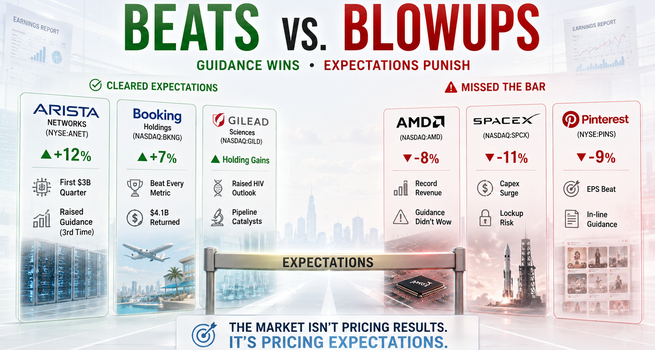
- Arista Networks is up more than 12% in premarket trading after its first-ever $3 billion revenue quarter and a third consecutive guidance raise this year.
- Booking Holdings and Gilead Sciences are also higher after both exceeded the high end of their own guidance ranges.
- AMD posted record revenue and an earnings beat, yet shares are down more than 8% in premarket trading on guidance that still fell short of sky-high expectations.
- SpaceX's first quarterly report as a public company beat on revenue and profitability, but the stock is down nearly 11% on capex and lockup concerns.
- Pinterest beat earnings estimates by nearly 20%, yet shares are down almost 9% as investors focused on in-line rather than upside third-quarter guidance.
The Beats
Arista Networks (NYSE:ANET) is the standout winner from Tuesday's after-close batch, trading up 12% in premarket on Wednesday to $214 after closing Tuesday's regular session up 3.04%. The networking equipment maker delivered its first-ever $3 billion revenue quarter, up 37.7% year over year and above its own $2.8 billion guidance, with earnings per share of $1.02 crushing the $0.89 consensus. Operating margin reached 49.9% and gross margin 63.4%.
Management raised full-year 2026 revenue guidance for the third time this year, to approximately $12.6 billion, up from a May guidance of $11.5 billion and an original Analyst Day target of $10.5 billion, while third-quarter guidance of roughly $3.3 billion in revenue and $1.06 to $1.08 in earnings per share came in well above the Street's approximately $2.94 billion and $0.91 estimates. The company has also nearly tripled its multi-year purchase commitments, from $3.6 billion a year ago to roughly $9.7 billion, securing memory supply through 2026 with visibility into 2027, while cumulative AI switching customers have grown past 100, up from just four or five in 2024.
Booking Holdings (NASDAQ:BKNG) is up 7% in premarket trading to $207.61, extending Tuesday's after-hours gain. The online travel giant exceeded the high end of its own guidance across every key financial metric, with room nights up 5%, gross bookings up 9%, revenue of approximately $7.4 billion beating the roughly $7.2 billion consensus, and adjusted earnings per share of $2.54 topping the $2.45 estimate.
That performance came despite ongoing indirect impacts from Middle East conflict on long-haul travel and flight capacity. Connected trip transactions, where customers book more than one travel component together, grew in the low double digits, more than double the company's overall transaction growth rate, while merchant gross bookings reached roughly 73% of the total. Management raised its transformation program's expected annual run-rate savings target to $550 million to $650 million, up from an original $450 million goal, and returned $4.1 billion to shareholders in the quarter, including $3.7 billion in buybacks.
Gilead Sciences (NASDAQ:GILD) closed Tuesday's regular session up 3.13% and is holding those gains in premarket trading today, essentially flat at $135.32. The biopharmaceutical company reported second-quarter revenue of $7.8 billion, beating the $7.4 billion consensus, driven by base business sales up 10% year over year to $7.6 billion. HIV sales grew 12% to $5.7 billion, with PrEP sales exceeding $1 billion for the first time as newer therapy Yeztugo doubled year over year, prompting management to raise full-year HIV growth guidance to 9% to 10%.
Oncology drug Trodelvy grew sales 26% to $457 million on new breast cancer approvals, and liver disease sales more than doubled year over year. Gilead also has several pipeline catalysts ahead, including an FDA decision on its Bictegravir/Lenacapavir combination expected by August 27 and a regulatory decision on cell therapy Anitocel in multiple myeloma due later this year.
The Blowups
AMD (NASDAQ:AMD) delivered a genuine beat and above-consensus guidance, then fell more than 8% in premarket trading anyway, down to $475.43 after closing Tuesday up 7.00%. Second-quarter revenue reached a record $11.5 billion, up 50% year over year and ahead of the $11.3 billion consensus, with data center revenue more than doubling to $6.7 billion, or 58% of total revenue. Non-GAAP earnings per share of $1.66 beat the $1.61 estimate and grew roughly 82% year over year, while third-quarter guidance of approximately $13 billion, up 41% year over year, also topped the roughly $12.94 billion analysts had modeled.
The stock fell anyway because that guidance still failed to satisfy what one market summary described as sky-high investor expectations for a "blowout" AI-driven forecast tied to the company's new Helios rack-scale platform, with analysts noting that Helios volumes will not ramp meaningfully until the fourth quarter. Coming into the print after a stock already up roughly 130% year to date, even a genuine beat-and-raise quarter, backed by new AI accelerator commitments from Anthropic and an expanded Microsoft Azure collaboration, was not enough to clear the bar.
SpaceX (NASDAQ:SPCX) posted its first quarterly report as a public company and fell nearly 11% in premarket trading to $111.26, despite closing Tuesday's regular session up 9.43%. Second-quarter revenue grew 92% year over year to $7.8 billion, beating the roughly $6.8 billion consensus, while the adjusted loss per share of $0.09 beat the $0.26 loss analysts had modeled, and adjusted EBITDA of $3.5 billion grew 191% year over year. Starlink added a record 1.7 million net subscribers during the quarter, and the company's AI segment, built on Nvidia architecture, saw revenue surge 247% year over year to $2.6 billion.
Despite that strength, investors focused on capital expenditures surging to $18.37 billion for the quarter on Starship and AI infrastructure buildout, a sales valuation near 40 times revenue, and an insider lockup expiration this Thursday that will free up roughly 911 million shares, worth approximately $104 billion at current prices, into the market. Chief executive Elon Musk pulled forward the company's internal $1 trillion annual revenue target to 2030 and floated a non-zero chance of $1 trillion in total revenue by 2029, but the forward-looking claims did little to offset near-term concerns over cash burn and share supply.
Pinterest (NYSE:PINS) rounded out the premarket decliners with one of the cleanest earnings beats of the six, followed by one of the sharpest reversals, down 9% in premarket trading to $23.29 after closing Tuesday up 5.88%. Second-quarter revenue grew 18% year over year to $1.2 billion, beating the $1.1 billion consensus, while earnings per share of $0.43 beat the $0.36 estimate by more than 19%.
Global monthly active users rose 11% to 640 million, marking a twelfth consecutive record quarter, and adjusted EBITDA of $311 million represented a 130 basis point margin improvement. Shares fell anyway once management guided third-quarter revenue to a range of $1.19 billion to $1.21 billion, only in line with rather than above consensus, and flagged specific sequential headwinds including a fading currency tailwind, the timing shift of Amazon's Prime Day into the second quarter, and the absence of a repeat World Cup advertising boost. Investors weighed that in-line guidance more heavily than the underlying user growth and margin improvement that drove the quarter's strength.
What the Divergence Signals
The clearest thread separating today's winners from its losers is not whether a company beat estimates, all six did, but whether the forward guidance cleared an already-elevated bar. Arista, Booking and Gilead each paired their beats with guidance that either matched or exceeded the high end of what the market had priced in, leaving little room for disappointment. AMD, SpaceX and Pinterest all delivered results that would have read as clean wins in isolation, yet each came bundled with a specific, quantifiable reason for caution, guidance still short of "blowout" territory in AMD's case, heavy capital spending and a looming share lockup in SpaceX's, and in-line rather than upside guidance loaded with one-off headwinds in Pinterest's.
That distinction matters more than usual this earnings season because so many of today's reports tie back to the same underlying theme of artificial intelligence infrastructure spending. Arista's networking hardware and AMD's AI accelerators serve the same buildout, yet one cleared expectations decisively while the other, despite genuinely stronger absolute numbers in some respects, did not. SpaceX's own AI compute segment grew revenue nearly 250% year over year, an extraordinary number that was still overshadowed by the capital intensity required to sustain it. The market's message across all six names is consistent: growth alone is no longer sufficient, and guidance has to clear a bar set by the market's own accumulated expectations, not just by the prior quarter's results.
Conclusion
Today's premarket session splits three clean beats against three names that beat on paper and still sold off, a pattern that has become increasingly familiar this earnings season. Arista, Booking and Gilead each delivered guidance with nothing left to question, while AMD, SpaceX and Pinterest offered strong headline numbers undercut by a specific, identifiable concern that the market chose to price first. With AI infrastructure spending and guidance credibility now the central storylines connecting nearly every major report, how quickly AMD's Helios ramp materializes, how SpaceX's capital intensity evolves ahead of Thursday's lockup expiration, and whether Pinterest's guidance headwinds prove temporary are likely to matter more for these stocks than any single quarter's headline beat.


 Nov 19, 2026





 Please wait processing your request...