
 CA
 NZ
 UK
 AU
 IND

 US

 Share
 X (Formerly Twitter)
 Whatsapp
 Facebook
 LinkedIn
 Telegram
 Email This Article
 Copy Link
 Summarize with AI
 Chat GPT
 Perplexity
Key Highlights
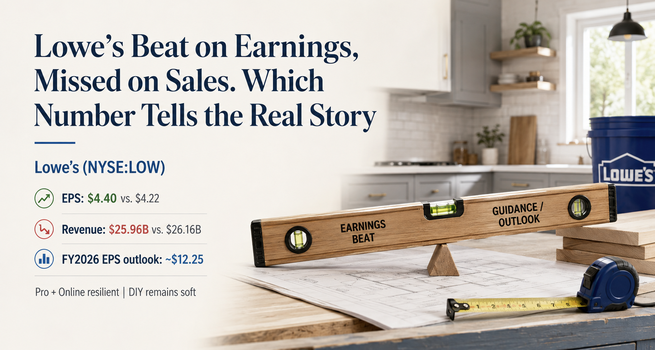
- Lowe's Companies posted second-quarter adjusted Earnings Per Share of 4.40 dollars, ahead of the 4.22 dollar consensus estimate, while Revenue of 25.96 billion dollars fell short of the 26.16 billion dollar forecast.
- The company narrowed its full-year 2026 outlook toward the lower end of its previous range, trimming adjusted Diluted Earnings per Share guidance to approximately 12.25 dollars from a prior range of 12.25 to 12.75 dollars.
- Comparable sales rose a modest 0.2 percent, marking a fifth consecutive quarter of positive comps, as Pro, online, and home services growth offset continued softness in discretionary DIY spending.
- The results follow rival Home Depot's description of a frozen housing market, reinforcing sector-wide caution around big-ticket home improvement demand.
A Beat That Comes With a Caveat
Lowe's (NYSE:LOW) second-quarter fiscal 2026 results present two different pictures depending on which line an investor chooses to focus on, but neither is the one that matters most. Adjusted diluted earnings per share of 4.40 dollars cleared Wall Street's 4.22 dollar estimate with room to spare, a result aided in part by an 11 cent per share benefit from IEEPA Tariff refunds recognized during the quarter. Revenue told a less flattering story, coming in at 25.96 billion dollars against a consensus estimate of 26.16 billion dollars, a shortfall that raises the question of how much of the earnings strength reflects genuine operating momentum versus one-off tailwinds and cost management.
The real signal, however, sits neither in the earnings beat nor the sales miss, but in what the company did next. Alongside these results, Lowe's quietly narrowed its full-year outlook toward the more conservative end of its own prior guidance, a move that says more about management's read on the rest of the year than either headline number does on its own.
As-reported diluted earnings per share was 4.27 dollars, essentially flat against the 4.27 dollars posted in the prior-year quarter. The gap between reported and adjusted figures stems from 96 million dollars in pre-tax expenses tied to intangible asset amortization from the company's acquisitions of Artisan Design Group and Foundation Building Materials, both excluded from the adjusted number.
What the Guidance Cut Reveals
Perhaps the more telling data point is not the quarter itself but what Lowe's chose to do with its full-year outlook. The company left its guidance ranges intact in structure but moved every figure to the bottom of the previously communicated band. Total sales guidance narrowed to approximately 92.0 billion dollars from a prior range of 92.0 to 94.0 billion dollars. Comparable sales guidance shifted from a range of flat to up 2 percent to simply flat. Adjusted diluted earnings per share guidance was trimmed to approximately 12.25 dollars from a prior 12.25 to 12.75 dollar range.
This is not a guidance cut in the conventional sense, since the low end of each range was left undisturbed. It is instead a narrowing of confidence, a signal that management now views the more conservative end of its own prior forecast as the base case rather than a downside scenario. For a retailer whose Business is closely tied to housing turnover and big-ticket discretionary spending, that shift matters more than the headline EPS beat.
Where the Growth Is Actually Coming From
Comparable sales growth of 0.2 percent was Lowe's fifth consecutive quarter of positive comps, a streak the company is keen to preserve. The composition of that growth is instructive. Strength came from Pro customer sales, home services, and a 15.7 percent increase in online sales. Weakness came from the DIY segment, where persistent macroeconomic pressure continues to weigh on Demand for discretionary and big-ticket projects.
This divergence mirrors a pattern seen elsewhere in the home improvement sector. Rival Home Depot, reporting a day earlier, described operating conditions as a frozen housing market, with customers continuing to defer larger renovation projects. Lowe's results, read alongside that commentary, suggest the softness is sector-wide rather than company-specific, tied to elevated Mortgage rates and weak existing-home sales turnover rather than any loss of competitive position.
Balance Sheet and Capital Allocation Context
Lowe's total Assets rose to 55.9 billion dollars as of July 31, 2026, up from 46.6 billion dollars a year earlier, reflecting the Balance Sheet impact of the FBM and ADG acquisitions, which added meaningfully to Goodwill and intangible assets. Long-term Debt increased to 35.2 billion dollars from 30.5 billion dollars over the same period. The company continued its capital return programme, paying 673 million dollars in dividends during the quarter and maintaining share repurchase activity, while Operating Cash Flow for the first half of the year came in at 7.0 billion dollars, moderately below the 7.6 billion dollars generated in the prior-year period.
Conclusion
Lowe's second quarter is a study in reading past the headline number. An earnings beat driven partly by a tariff refund and acquisition-related cost adjustments looks less impressive once set against a revenue miss and a guidance range that management has quietly walked toward its more cautious end. The underlying operating story, a resilient Pro and services business offsetting a genuinely weak DIY consumer, is consistent with what Home Depot (NYSE:HD) described a day earlier, suggesting the pressure is structural to the housing cycle rather than specific to either retailer. For investors, the more useful signal from this release may not be the 4.40 dollar adjusted EPS figure but the fact that management no longer sees the upper half of its own full-year range as achievable.


 Nov 19, 2026





 Please wait processing your request...