
 CA
 NZ
 UK
 AU
 IND

 US

 Share
 X (Formerly Twitter)
 Whatsapp
 Facebook
 LinkedIn
 Telegram
 Email This Article
 Copy Link
 Summarize with AI
 Chat GPT
 Perplexity
Key Highlights
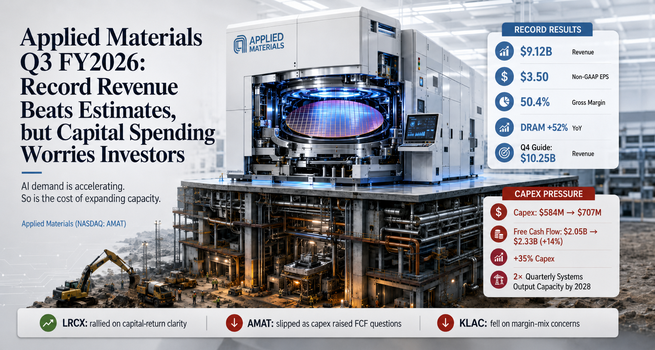
- Applied Materials reported record fiscal third-quarter Revenue of 9.12 billion dollars, up 25 percent year over year, with record non-GAAP Earnings Per Share of 3.50 dollars.
- Fourth-quarter guidance of 10.25 billion dollars in revenue and 4.02 dollars in non-GAAP earnings per share points to continued acceleration into fiscal 2027.
- A roughly 35 percent increase in Capital Expenditure left free Cash Flow largely flat for the nine-month period despite substantially higher net income.
- Management is investing to double quarterly system output capacity by 2028, a commitment central to both the growth thesis and the near-term Margin of investor caution.
- Shares moved lower in premarket trading even after beating consensus, a reaction that diverges from peers reporting similarly strong results this earnings season.
Record Results, a More Cautious Market Response
Applied Materials delivered what its own management described as a record-breaking quarter. Revenue climbed to 9.12 billion dollars, the strongest sequential growth in the company's history, while non-GAAP gross margin expanded to 50.4 percent and Operating Margin reached a record 34.0 percent, marking the thirteenth consecutive quarter of year-over-year gross margin expansion.
Chief executive Gary Dickerson called it "the highest quarter-on-quarter revenue growth in the company's history."
Non-GAAP earnings per share reached a record 3.50 dollars, up 41 percent year over year, comfortably ahead of consensus estimates.
Yet the market reaction was not straightforwardly positive. Shares fell in premarket trading despite the company beating estimates on every headline metric, a divergence that points to a more complex set of concerns among institutional investors than the results alone would suggest. The tension traces back to two narratives management itself acknowledged on the earnings call. The first is a Demand story of exceptional strength, with chief executive Gary Dickerson describing an environment where customer forecasts now extend eight quarters on a rolling basis, and for some of the company's largest customers, visibility into technology roadmaps stretching toward 2030. The second is a capital intensity story, in which meeting that demand requires materially higher investment, a commitment that pressures free cash flow in the near term even as it positions the company for multi-year growth.
 Source: Applied Materials Q3 FY2026 Earnings Release
Where the Growth Is Coming From
Applied's Semiconductor Systems segment generated record revenue of 7.04 billion dollars, up 27 percent year over year, with non-GAAP operating margin expanding to 38.0 percent. Within that segment, DRAM revenue, which includes high-bandwidth memory packaging, grew 52 percent year over year to record levels, reflecting the surge in memory demand tied to AI Training and inference workloads. Chief financial officer Brice Hill indicated the second half of the calendar year would see a further significant increase in DRAM revenue as customers expand clean room capacity.
Applied Global Services also posted record revenue of 1.78 billion dollars, up 22 percent year over year, with operating margin reaching 30.1 percent, its highest level in roughly two years. Management now expects services revenue to grow more than 20 percent for calendar 2026, supported by more than 37,000 chambers connected to the company's AIx diagnostics platform. Advanced packaging revenue is expected to grow more than 70 percent in calendar 2026, an area management has identified, alongside leading-edge foundry logic and DRAM, as representing approximately 80 percent of wafer fab equipment growth industry-wide.
The Capital Expenditure Question
The most consequential disclosure for near-term financial modeling was management's confirmation that Applied is building capacity to double quarterly system output by 2028, supported by the recent opening of a new Manufacturing center in Singapore and plans for further expansion. Capital expenditures for the nine months ended July 26, 2026 rose to 1.99 billion dollars, up from 1.48 billion dollars a year earlier, a roughly 35 percent increase that has weighed on free cash flow conversion even as Operating Cash Flow reached record levels.
Non-GAAP free cash flow for the nine-month period was 3.58 billion dollars, essentially flat against 3.66 billion dollars in the prior-year period, despite substantially higher net income. Management characterized this as a function of long-lead-time Investment rather than a deterioration in underlying profitability.
Hill told analysts Applied is "making additional manufacturing capacity investments to support projected demand through the end of the decade."
Whether investors treat this as a temporary drag ahead of a demand-driven payoff, or as a structural feature warranting a more conservative valuation multiple, is the central point of disagreement reflected in analyst price target revisions following the results.
How Analysts Are Reading the Results
The premarket share price decline followed a mixed set of analyst reactions. Morgan Stanley and Deutsche Bank both trimmed price targets, with commentary pointing to implied systems shipment growth of approximately 42 percent falling short of the more optimistic 44 percent or higher expectations some investors had built into the stock following prior quarters of upward revisions. Bank of America also lowered its target, while RBC moved in the opposite direction, raising its target on the strength of the AI-driven demand outlook. This split suggests the disagreement is not about whether Applied's underlying demand environment is strong, which appears broadly accepted, but about how much of that strength is already reflected in a share price that had risen sharply on a year-over-year basis heading into the print.
A Reaction That Stands Apart From Peers
Applied's premarket pullback is notable set against how the market treated similarly strong results elsewhere in the sector this earnings season. Lam Research (NASDAQ:LRCX) reported fiscal fourth-quarter revenue of 6.72 billion dollars, up 15 percent sequentially and 30 percent year over year, with record Diluted Earnings per Share of 1.82 dollars and gross margin of 52 percent, and its shares rallied close to 18 percent, aided by an explicit long-term commitment to return at least 85 percent of free cash flow to shareholders. KLA Corporation (NASDAQ:KLAC) posted record revenue of 3.66 billion dollars with the highest gross margin in the peer group at 62.4 percent, yet its shares fell nearly 11 percent on concerns tied to margin mix rather than demand. ASML Holding (NASDAQ:ASML) reported net sales of 9.3 billion euros, above the high end of its own guidance, and saw a more modest share price gain after raising full-year guidance.
The pattern suggests that Applied's non-GAAP gross margin of 50.4 percent, the lowest among this peer group though reflective of a different product mix rather than a competitive shortfall, is not on its own what is driving investor caution. Lam's margin sits close to Applied's, yet its stock moved sharply higher. The more likely explanation is that Lam paired its results with a quantified, forward-looking capital return framework, something Applied has not yet offered in comparable detail, leaving capital intensity as the more prominent, unresolved variable in how the market is currently pricing Applied's growth investment.
What the October Investor Event Needs to Resolve
Applied's fourth-quarter guidance calls for revenue of 10.25 billion dollars, plus or minus 500 million dollars, representing 51 percent year-over-year growth, alongside non-GAAP earnings per share of 4.02 dollars. Semiconductor Systems revenue within that guidance is expected near 7.9 billion dollars, up 62 percent year over year. Management reiterated confidence in another strong growth year for fiscal 2027, citing the eight-quarter rolling forecasts now standard among its largest customers, though it declined to provide specific quantitative guidance beyond the fourth quarter, deferring longer-term targets to an investor event scheduled for October at the company's new EPIC Center in Silicon Valley.
That event, alongside newly announced research partnerships involving Broadcom, UC Berkeley, and SCREEN Semiconductor Solutions, is where management will need to make its case most directly. The current quarter has already established that demand is not in question. What remains unresolved is the same question that separated Applied's premarket pullback from Lam's rally: how much of the current capital expenditure is temporary investment ahead of a payoff, and how much represents a lasting shift in the capital intensity required to compete in AI-driven memory and packaging. A clearer framework for capital allocation and free cash flow conversion, of the kind peers have already offered, would give investors a firmer basis for judging whether the current buildout phase is a drag on valuation or the foundation for the next leg of margin expansion.


 Nov 20, 2026





 Please wait processing your request...