
 CA
 NZ
 UK
 AU
 IND

 US

 Share
 X (Formerly Twitter)
 Whatsapp
 Facebook
 LinkedIn
 Telegram
 Email This Article
 Copy Link
 Summarize with AI
 Chat GPT
 Perplexity
Key Highlights
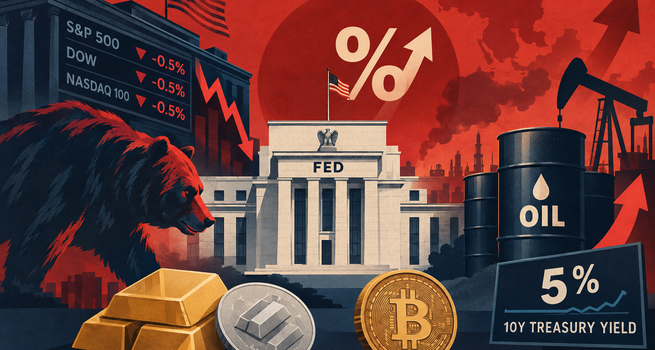
- The S&P 500, Dow, and Nasdaq 100 fell up to 0.5% Tuesday as rising bond yields and Middle East tensions weighed on sentiment.
- Brent crude rose to around $107.50 a barrel, near a four-month high, after Saudi Arabia's East-West pipeline shut down.
- The US 10-year Treasury Yield climbed above 5%, its highest level since July 2007.
- Markets are pricing in roughly a 92% chance of a 25 basis point Fed rate hike on Wednesday, which would be the first hike since 2023.
US markets moved lower on Tuesday as a combination of surging oil prices, an intensifying Global Bond selloff, and mounting expectations for a Federal Reserve rate hike this week weighed on risk Assets across equities, commodities, and cryptocurrency. The session extended Monday's pullback, with the S&P 500, Dow, and Nasdaq 100 each falling up to 0.5%, while the US 10-year Treasury yield pushed above 5% for the first time since July 2007. Taken together, the day's moves reflected a market grappling simultaneously with a geopolitically driven energy shock and a domestic policy shock, both pointing in the same inflationary direction.
Equities: AI Hyperscalers Lag, Chipmakers Rebound
Long-maturity yields rose further as the escalation of strikes in the Middle East worsened the outlook for energy Supply from the region, magnifying Inflation risks and reinforcing the case for a hawkish Federal Reserve response. Markets expect the Fed to hike rates by 25 basis points on Wednesday as fuel prices have driven underlying inflation to gain traction this year.
Most sectors were lower, with credit-sensitive AI hyperscalers leading the losses as their increasing Debt positions clash against higher borrowing costs; Alphabet, Microsoft, and Meta each fell 1%. Chip producers, however, rebounded from the prior session's slump as markets assessed how emerging risks to AI safety could slow infrastructure spending rather than eliminate it entirely, with Nvidia, Lam Research, and Intel each gaining 1%. That split, hyperscalers down and chipmakers up, illustrates how investors are separating balance-sheet exposure to rising rates from the underlying Demand narrative for AI hardware.
The divergence within the AI complex is likely to remain a theme worth watching in coming sessions, since it suggests investors currently view the risk of higher financing costs and the risk of slower AI capability growth as two distinct, and not necessarily correlated, sources of pressure on the sector.
Oil: Saudi Pipeline Outage Meets Diplomatic Crosscurrents
Brent crude rose to around $107.50 a barrel on Tuesday, near a four-month high, following a 1% gain in the previous session, as supply disruptions in the Middle East outweighed signs of progress toward a Russia-Ukraine energy truce. Market concerns remain focused on Saudi Arabia, where the East-West pipeline has been shut, removing an important alternative export route that reduces reliance on the Strait of Hormuz. Riyadh is reportedly seeking to increase shipments through the strategic waterway while the pipeline remains offline, though repairs could take several weeks; US Energy Secretary Chris Wright has indicated he expects the pipeline to resume operations soon.
Diplomatic efforts are gaining momentum elsewhere even as the Saudi disruption persists. US President Donald Trump announced a truce on strikes against Russian and Ukrainian energy facilities, while Turkey is seeking to broker an agreement between Kyiv and Moscow to end attacks on Black Sea shipping. Ukraine, however, disputed Trump's characterization that an agreement had already been reached, adding a layer of uncertainty to how durable that truce actually is.
The net effect is a market pricing two offsetting geopolitical currents at once: a live supply disruption in the Middle East pushing prices higher, and a tentative, disputed de-escalation in Eastern Europe that has not yet been enough to offset it.
Precious Metals: Gold and Silver Slide Near Five-Week Lows
Gold traded around $4,300 an ounce on Tuesday, hovering near five-week lows, while silver traded near $63 an ounce, also near five-week lows. Both metals are under pressure from the same combination of forces: elevated oil prices strengthening expectations for a Fed rate hike this week, and the US 10-year Treasury yield climbing toward 5%, both of which raise the Opportunity cost of holding non-yielding assets. Markets are currently pricing in roughly a 92% chance of a 25 basis point rate hike on Wednesday.
Adding to the pressure, the Bank of Japan is also expected to raise rates on Friday, as elevated energy costs and ongoing Middle East tensions continue to complicate the inflation outlook well beyond US borders. The prospect of tightening from two major central banks in the same week has left little room for non-yielding metals to catch a bid.
Bitcoin and Broader Indexes Under Pressure
Bitcoin traded at $76,899 on Tuesday, down $1,260, or 1.61%, on the day, and down 22.41% over the last four weeks and 34.18% over the last 12 months, reflecting how sharply risk appetite has cooled for the asset even as broader Equity indexes have posted more modest declines. Trading Economics forecasts Bitcoin to reach $77,811 by the end of the quarter and $87,311 in one year.
The Dow-tracking US30 index traded at 52,353 on Tuesday, down 0.29% on the day and 2.07% over the last four weeks, though still up 14.41% over the last 12 months. Trading Economics forecasts the index at 51,448 by the end of this quarter and 48,215 in one year, implying further downside if that projection holds.
The Fed Backdrop: July Minutes and a Historical Warning
The Federal Reserve's July meeting minutes showed policymakers remained concerned about persistent inflation and the possibility that further rate increases could be required if price pressures Fail to ease. Several officials judged that financial conditions may not have been restrictive enough, while a small group who supported a July hike believed an immediate move could have reduced the need for larger increases later. Notably, that meeting took place before subsequent data showed cooler employment and inflation, meaning the minutes may overstate the tightening currently priced into markets.
Even so, Wall Street firmly expects a hike this week. The CME Group's FedWatch tool points to an 87% probability of a quarter-point increase at the FOMC meeting ending September 16, taking the federal funds rate target to 3.75% to 4%, with another quarter-point hike expected in December. Inflation has stayed above the Fed's 2% target since February 2021, a streak of 66 straight months, and Fed Chair Kevin Warsh said in August that responsibility for sustained, elevated inflation sits squarely with the central bank.
History offers a cautionary note for equity investors. The Fed has only initiated three rate-hike cycles in the last 25 years, in June 2004, December 2015, and March 2022, and after the first hike in each cycle, the S&P 500, Nasdaq Composite, and Dow Jones have, on average, suffered maximum drawdowns of 11%, 17%, and 10%, respectively, within the following three months. That said, corporate fundamentals currently look stronger than in some prior cycles: S&P 500 companies reported 15% Revenue growth and 31% Earnings growth, excluding unrealized gains, in the second quarter, the fastest paces in years, driven substantially by the AI boom.


 Nov 02, 2026
 Please wait processing your request...