
 CA
 NZ
 UK
 AU
 IND

 US

 Share
 X (Formerly Twitter)
 Whatsapp
 Facebook
 LinkedIn
 Telegram
 Email This Article
 Copy Link
 Summarize with AI
 Chat GPT
 Perplexity
Key Highlights
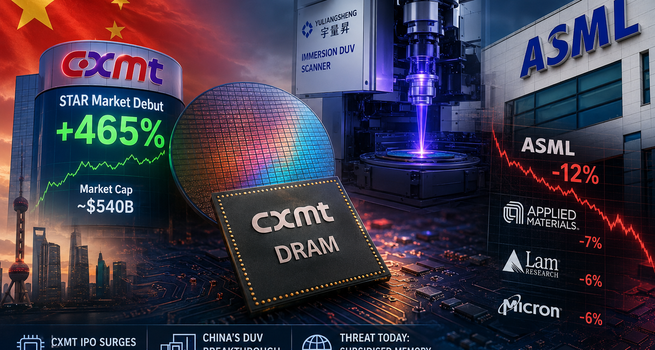
- CXMT’s Shanghai STAR Market debut surged roughly 465–500%, lifting the DRAM maker’s market value to about $487bn–540bn on an IPO that raised some $8.6bn–9.8bn.
- Reports that state-backed Yuliangsheng has begun mass-producing immersion DUV scanners, with 2026 deliveries to CXMT and SMIC, hit equipment stocks. ASML (NASDAQ: ASML) is down about 12%.
- Applied Materials (NASDAQ: AMAT) and Lam Research (NASDAQ: LRCX) fell 5–8%; Micron (NASDAQ: MU) and SanDisk (NASDAQ: SNDK) also slid.
- China’s tools remain generations away from EUV. The nearer-term threat to Western firms is subsidised memory supply, not lithography substitution.
A debut that levitated
For a company that spent most of its existence as a line item in Beijing’s industrial policy, ChangXin Memory Technologies has arrived in public markets with startling force. Its listing on Shanghai’s STAR Market sent the stock up by something between 465% and 500% on debut, hauling the memory maker’s market capitalisation to somewhere in the region of $487bn to $540bn and installing it, on paper, among China’s most valuable listed companies. The offering itself raised roughly $8.6bn to $9.8bn, placing it among the largest semiconductor listings anywhere, ever.
Set that against a plainer set of facts. CXMT is the world’s fourth-largest producer of dynamic random-access memory (DRAM), the commodity chip that holds data while a processor works on it. Its share of global output is in the high single digits measured in bits. Micron (NASDAQ: MU), the American number three, ships several times as much, sells into the most lucrative corner of the market — high-bandwidth memory (HBM) for artificial-intelligence accelerators — and is worth a fraction of CXMT’s new valuation. Samsung Electronics (KRX: 005930) and SK Hynix (KRX: 000660), which between them command the majority of the industry’s bits and nearly all of its HBM profits, are similarly outranked by a firm that has yet to prove it can make an HBM stack at scale.
Investors, in other words, are not pricing a memory company. They are pricing a policy. Chinese retail markets have long treated newly listed national champions as call options on state ambition; SMIC (SHA: 688981) enjoyed a similar reception when it listed in Shanghai in 2020, and its shares subsequently spent years working off the excess. The froth is not the interesting part of the story. What matters is that the froth is cheap. A company valued at half a trillion dollars can raise equity almost at will, and a memory business that need not answer to the cost of capital is a memory business that need not answer to the cycle either. That is the competitive weapon, and it does not require a single new machine to be built.
The second shock
The machines, however, were the other half of the week’s news. Accounts emerged that Yuliangsheng, a state-backed Chinese lithography developer, had begun mass production of immersion deep-ultraviolet (DUV) scanners, with first deliveries slated for 2026 to customers including CXMT and SMIC (SHA: 688981), and output intended to rise sharply through 2027. For a country that has spent two decades and a great deal of money failing to build a competitive lithography tool, this is a claim of consequence.
Markets treated it as such. ASML (NASDAQ: ASML), the Dutch firm that supplies close to nine-tenths of the world’s lithography equipment and all of its extreme-ultraviolet (EUV) systems, fell hard and is now down some 12% since the news. Japanese toolmakers slipped. Applied Materials (NASDAQ: AMAT) and Lam Research (NASDAQ: LRCX) dropped 5–8%, though neither makes a lithography scanner. Micron (NASDAQ: MU) and SanDisk (NASDAQ: SNDK) declined on a different logic altogether: not that China will build the tools, but that China will use them.
The breadth of the selling is a clue that the market conflated two quite distinct threats. One is a supply threat to the equipment industry — Chinese scanners displacing imported ones. The other is a demand threat to the memory industry — Chinese bits displacing Korean, American and Taiwanese ones. Only one of these is imminent, and it is not the first.
What immersion DUV can and cannot do
Immersion lithography is a mature technology, and that is precisely why it was a plausible target for Chinese engineers. An argon-fluoride laser produces light at 193 nanometres; a film of purified water between the final lens and the wafer raises the effective numerical aperture to 1.35, which yields a single-exposure resolution of roughly 38nm half-pitch. Everything finer is achieved by trickery: exposing the same layer two or four times with offset patterns, or depositing and etching spacers to double the pitch. SMIC has used such multi-patterning to manufacture 7nm-class logic on ASML’s existing immersion tools, and CXMT has pushed DRAM to something close to a 16nm-class node the same way.
The trickery is not free. Each additional patterning step means another mask, another deposition, another etch, another round of metrology, more cycle time and more opportunities for a defect. Yields fall, costs rise, and the economics grow steadily worse as the node shrinks. This is why EUV existed in the first place: a single 13.5nm exposure replaces four DUV ones. A Chinese fab equipped with domestic immersion scanners can therefore make competitive commodity DRAM and respectable mature-node logic. It cannot make leading-edge logic economically, and it will struggle to reach the densest DRAM nodes that Samsung, SK Hynix and Micron now pattern with EUV.
Nor is a first-generation tool comparable to ASML’s. The relevant specifications are throughput and overlay accuracy — how many wafers an hour a scanner processes, and how precisely it can align one layer to the one beneath. ASML’s current immersion workhorses handle roughly 300 wafers an hour with overlay in the low single-digit nanometres, figures reached through two decades of iteration. A newly productionised machine will not match them. In high-volume manufacturing, a scanner that is 30% slower and less accurate does not cost 30% more; it degrades the economics of every subsequent step. Chinese fabs will run these tools where the penalty is tolerable and keep their ASML systems on the layers that matter.
The parts nobody photographs
There is also the question of what a lithography company actually is. ASML (NASDAQ: ASML) designs and integrates; it does not make its own optics. Those come from Carl Zeiss SMT, whose mirrors and lenses are polished to tolerances that have no commercial equivalent anywhere else on earth, and whose relationship with ASML is exclusive and decades deep. The light source for EUV — tin droplets vaporised by a high-power carbon-dioxide laser fifty thousand times a second — was acquired outright when ASML bought Cymer. Around these sit photoresists from a handful of Japanese chemical firms, pellicles, masks from Hoya and AGC, and the metrology systems of KLA (NASDAQ: KLAC) that tell a fab whether any of it worked.
Reproducing a scanner is thus the visible portion of a much larger problem. China has made genuine progress across this stack — Naura and AMEC in deposition and etch, SiCarrier across a broad tool portfolio — and the direction of travel is unmistakable. But optics and resist are the slowest-moving links, and they are where an aspiring competitor’s schedule tends to slip quietly. Prudence suggests treating the 2026 delivery target as an intention rather than a fact, and the 2027 volume ramp as an intention about an intention.
Where ASML actually sits in the AI value chain
It is worth being precise about this, because the label “AI stock” has been applied to ASML (NASDAQ: ASML) with more enthusiasm than accuracy. The company sells no chips. It sits two full layers upstream of the accelerators that Nvidia (NASDAQ: NVDA) designs and TSMC (NYSE: TSM) manufactures, and it captures value not from AI demand directly but from the capital expenditure that AI demand provokes.
That exposure runs through three channels. The first and most valuable is leading-edge logic. Every AI accelerator, and every custom silicon programme run by a hyperscaler, is fabricated on a process node that is physically impossible without EUV. TSMC (NYSE: TSM), Samsung (KRX: 005930) and Intel (NASDAQ: INTC) are the only buyers, and ASML is the only seller. A standard EUV system costs somewhere above $200m; the High-NA machines now entering the market, which raise numerical aperture to 0.55 for the nodes beyond, run to roughly twice that. There is no second supplier, no substitute technology, and no plausible Chinese entrant this decade.
The second channel is memory, and it is the one this week’s news actually touches. AI accelerators are useless without bandwidth, and bandwidth means HBM: stacks of DRAM dies connected by through-silicon vias and mounted alongside the logic. HBM is capacity-hungry in a way that flatters the whole memory industry, because each bit of HBM consumes more wafer area and yields worse than a bit of conventional DRAM. The scramble to serve AI has therefore drained the supply of ordinary memory and driven prices sharply higher. Making those denser DRAM nodes requires EUV for the critical layers — SK Hynix (KRX: 000660) adopted it earliest, Samsung followed, Micron (NASDAQ: MU) has moved to it for its latest node — which is why ASML now sells EUV to memory makers as well as logic ones.
The third channel is the enormous installed base of DUV, which patterns the non-critical layers of everything and constitutes the bulk of ASML’s unit volume, along with a service and upgrade business that compounds quietly. This is where Chinese competition bites — and it is the least valuable of the three. Moreover, much of the Chinese demand in question is demand ASML is already forbidden to serve. Dutch export controls have barred sales of its most advanced immersion systems to China since 2023, and America has restricted HBM exports besides. ASML’s Chinese revenue share has already fallen sharply from its 2024 peak. A domestic Chinese scanner substituting for a machine ASML cannot legally ship is a smaller loss than a 12% share-price fall implies.
The honest summary is that ASML’s moat is not one moat but a moat around a moat. The outer ring — mature-node DUV in China — is being drained. The inner ring, EUV, is not being approached. Investors selling the second because of news about the first are making a category error, albeit an understandable one: monopolies are repriced on sentiment long before they are broken on fact.
The threat that is actually near
Memory, by contrast, has a real problem. DRAM is a commodity with three disciplined suppliers, and its recent profitability rests entirely on that discipline. Samsung (KRX: 005930), SK Hynix (KRX: 000660) and Micron (NASDAQ: MU) have spent a decade learning not to build capacity into weakness. A fourth supplier with state funding, a domestic market mandated to buy from it, and an equity valuation that makes the cost of capital a rounding error is a direct assault on that arrangement.
The mechanism is unglamorous. CXMT does not need to make HBM4 to hurt the incumbents. It needs only to flood the low end — DDR4, DDR5, LPDDR for handsets and consumer devices — with subsidised bits, which pushes the incumbents to concentrate on the premium tier, compresses commodity pricing, and shortens whichever upcycle the industry happens to be enjoying. That is the reason Micron (NASDAQ: MU) and SanDisk (NASDAQ: SNDK) fell alongside the equipment names. It is a slower story than a lithography breakthrough and a more consequential one. The counterargument is the memory cycle’s own history: every prior attempt to buy market share in DRAM, from Japan in the 1980s to Taiwan in the 2000s, has destroyed a great deal of capital, including some of the buyer’s.
For the equipment industry the arithmetic runs the other way, at least initially. A new Chinese DRAM entrant scaling capacity buys deposition, etch, cleaning and metrology tools by the hundred, and lithography is only a fifth or so of a fab’s equipment budget. Applied Materials (NASDAQ: AMAT), Lam Research (NASDAQ: LRCX) and KLA (NASDAQ: KLAC) sell into that build-out until they are prevented from doing so, or until domestic rivals such as Naura and AMEC displace them — which, on current evidence, is the more likely constraint. Their falls of 5–8% look less like an assessment of 2026 orders than a reflex.
What to watch
Three markers will settle this faster than any share price. First, whether Yuliangsheng’s scanners are actually installed and qualified in production lines at CXMT and SMIC (SHA: 688981) during 2026, and at what throughput and overlay — qualification, not shipment, is the milestone that counts. Second, whether CXMT ships HBM in volume to a customer that has alternatives, which would demonstrate that DUV multi-patterning and advanced packaging can reach AI-grade memory without EUV. Third, ASML’s (NASDAQ: ASML) bookings for EUV and High-NA systems, which are the only reliable measure of whether the inner moat is intact.
Until those questions are answered, the week’s events are best read as a repricing of narrative rather than of cash flows. China has demonstrated that it can build a machine ASML was already barred from selling it, and has floated a memory company at a valuation that says more about Chinese retail investors than about global DRAM economics. Both facts matter. Neither is the one the market appeared to trade.


 Nov 10, 2026





 Please wait processing your request...