
 CA
 NZ
 UK
 AU
 IND

 US

 Share
 X (Formerly Twitter)
 Whatsapp
 Facebook
 LinkedIn
 Telegram
 Email This Article
 Copy Link
 Summarize with AI
 Chat GPT
 Perplexity
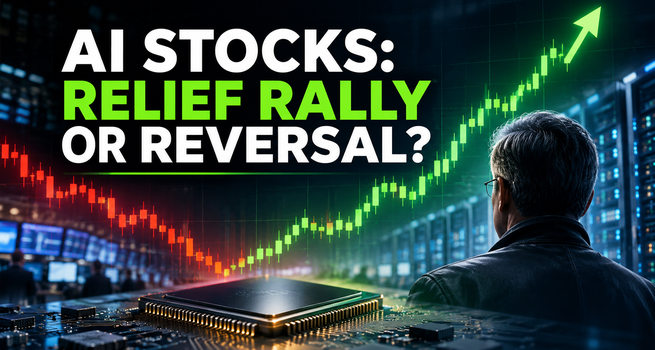
Nvidia (NASDAQ:NVDA) surged 31% and the Nasdaq posted its best day since April 2025 after Jensen Huang's reinstatement. But the anatomy of Monday's move argues for caution before declaring the AI correction over.
Key Highlights
- Nvidia surged 31.48% to $165.05 on November 23, adding about $1 trillion in value.
- The Nasdaq jumped 6.51%, its biggest gain since April 2025; semiconductors rose about 14%.
- The prior week, the Nasdaq lost about 10%; Nvidia ended roughly 48% below its peak.
- Even after the surge, Nvidia trades near 10x forward earnings, versus 40x+ at peaks.
- Fiscal Q3 FY2027 Revenue rose 103% year-over-year to $115.8 billion.
- Nvidia fell about 5% premarket Tuesday and Nasdaq futures 1.6% to 1.7%, a relief-rally pattern.
A Relief Surge Across Global Markets
Monday, November 23, 2026, delivered one of the sharpest single-day recoveries the technology sector has seen in years. Jensen Huang's reinstatement as Nvidia's president and chief executive took effect immediately, less than two weeks after his resignation amid a personal scandal involving an extramarital affair with a woman alleged to be a Chinese intelligence operative. The news triggered a relief rally that swept from Santa Clara to Seoul.
Nvidia led the move. The stock gained 31.48% to $165.05, its best one-day percentage move in over two decades, and added somewhere between $952 billion and $1 trillion in market Capitalization in a single session. The rest of the market followed. The Nasdaq Composite climbed 6.51% to 24,089.56, its largest daily gain since April 9, 2025, while the Nasdaq-100 gained roughly 6.86% and the Philadelphia Semiconductor index surged approximately 14%. The S&P 500 advanced 4.73% to approximately 7,237, and the Dow Jones Industrial Average rose about 1,448 points, or 3%, to close near 49,595. Asian markets followed suit overnight: Taiwan's Equity benchmark jumped nearly 9%, South Korea's KOSPI rose over 7%, and Japan's Nikkei advanced as much as 5%.
The breadth of the move underscored how much of the recent sell-off had been driven by a single variable: confidence in Nvidia's Leadership and, by extension, in the central nervous system of the global artificial intelligence infrastructure buildout.
The Sell-Off That Set the Stage
Monday's gains need context, and the context is how far prices had fallen. Nvidia had traded as high as $243.37 on October 6 and was still in the $186 to $200 range in early November. It then lost significant ground as leadership uncertainty escalated following Huang's resignation around November 12. By November 20, the day his departure triggered the worst of the damage, the stock had closed at $125.53, a decline of approximately 48% from its 52-week peak.
The broader indexes suffered in parallel. On November 20 alone, the Nasdaq Composite fell 5.28% to 22,617.73, while the S&P 500 dropped 3.70% to 6,910.39. For the week ended November 20, the Nasdaq lost approximately 10% and the S&P 500 shed about 8.6%, among the worst weekly performances for both indexes since early 2025.
Yet the sell-off was not purely about Huang. Concerns had been accumulating for weeks, including elevated valuations across AI-related equities, questions about the sustainability of massive hyperscaler capital expenditures, rising Debt Financing for data-center construction, potential regulatory scrutiny in the wake of midterm election results, and geopolitical exposure around chip exports to China. Huang's departure intensified fears about execution and governance at precisely the company that sits at the center of the AI infrastructure buildout. Many AI-adjacent names, including neocloud providers, power and cooling infrastructure companies and AI software platforms, remained well below their earlier peaks even after Monday's broad recovery.
Fundamentals vs Sentiment
Throughout the volatility, Nvidia's underlying Business kept delivering numbers that most companies would find difficult to match in a decade of operation. Fiscal third-quarter FY2027 revenue reached $115.8 billion, up 103% year-over-year, with Data Center revenue accounting for approximately $107.6 billion of that total. The Vera Rubin platform generated nearly $20 billion in its first quarter of commercial shipments, the fastest product ramp in Nvidia's history. Management guided fiscal fourth-quarter revenue of approximately $130 billion and raised the fiscal 2028 revenue growth outlook to roughly 75% year-over-year, up from a prior target of around 70%. Gross margins held near 75%.
Against those figures, the valuation reset was stark. Even after a 31% surge on Monday, Nvidia was trading at a trailing price-to-earnings multiple of roughly 17x to 18x, based on trailing twelve-month diluted Earnings per share in the vicinity of $9.30. On fiscal 2028 estimates, several research houses place the forward multiple near 10x, a level that implies a significant rerating opportunity relative to the stock's own history. At the multi-year peaks of the recent AI cycle, Nvidia regularly commanded forward multiples north of 40x, and even the broader semiconductor sector rarely dips to such low levels while delivering three-digit revenue growth.
Valuation Reset: The Numbers
The scale of the reset deserves emphasis. At roughly $165, with fiscal 2028 revenue guidance implying growth near 75% and gross margins near 75%, Nvidia traded at a forward P/E in the vicinity of 10x. That sits dramatically below both its own historical average and typical sector multiples for companies growing at half the pace. By any conventional framework, whether the PEG ratio, relative growth-adjusted valuation or a simple comparison with other large-cap technology companies, the stock appeared inexpensive.
That inexpensiveness reflects the degree to which the leadership episode compressed the premium the market had assigned to Nvidia's governance and strategic vision. Before Huang's resignation, investors had priced in not just the current revenue run rate but a sustained ability to maintain technological leadership, navigate export controls and execute on successive platform generations. The abrupt loss of the architect of that strategy, together with the geopolitical dimensions of the circumstances, created a discount that went beyond what the earnings numbers alone would justify.
Monday's move recovered a portion of that lost premium, but it did not restore it fully. Nvidia at $165 remained approximately 32% below its October peak, and many AI infrastructure names continued to trade 50% to 70% or more off their 2026 highs, even after benefiting from the broader sector lift.
Analysts responded accordingly. Multiple firms issued upgrades or reaffirmed buy ratings following Monday's trading session, with price targets clustered in the $200 to $270 range, implying further upside of roughly 20% to 60% from the closing price of $165.
Relief Rally or Trend Reversal?
Despite the scale of the recovery, Monday's action has the characteristic signature of a relief rally on the resolution of a known overhang, rather than the opening of a new structural uptrend. Several features of the move support that reading.
The Bounce Itself Is a Warning Sign
The speed and scale of the rebound deserve caution. A 31% move in a single session for a company of Nvidia's market capitalization, in the absence of an earnings report or a major product announcement, reflects the unwinding of a forced discount rather than fresh capital deployment based on revised growth expectations. When a rally is about removing a negative rather than establishing a positive, the subsequent path tends to be more uncertain.
Tuesday's Fade
Trading the next day reinforced that reading. Tuesday, November 24, the day this analysis was written, showed precisely the profit-taking behavior associated with relief rallies. Nasdaq futures fell approximately 1.6% to 1.7%, Nvidia traded down roughly 5% in premarket trading, and other semiconductor and neocloud names declined 4% to 6%. These are ordinary and expected developments after a 6% to 7% index day, but they illustrate that the gains were not built on a foundation of new buying conviction.
Structural Risks Remain
Most importantly, the structural risks that accumulated through October and November have not been resolved. Hyperscaler Capital Expenditure remains at historically extreme levels. Amazon (NASDAQ:AMZN), Alphabet (NASDAQ:GOOGL), Microsoft (NASDAQ:MSFT) and Meta (NASDAQ:META) collectively guided approximately $730 billion in total capex for 2026. Analyst estimates for 2027 range from $900 billion to $1.2 trillion, with Goldman Sachs (NYSE:GS) citing figures near the upper end of that range when Oracle (NYSE:ORCL) and other adjacent spending is included. Third-quarter 2026 spending by that group already approached or exceeded $200 billion in a single quarter.
Multiple research houses have flagged that this pace of spending is outrunning current AI-related revenue and returns, with free Cash Flow turning negative at several hyperscalers and significant debt issuance funding the construction cycle. Circular financing relationships and elevated valuations in leveraged players add fragility to the system.
Macro and policy risks persist as well. Inflation data, Federal Reserve rate expectations, potential tightening of AI regulation and export controls on advanced semiconductors all remain active variables. Nvidia's implied Volatility stayed elevated after Monday's move, and the VIX remained well above its long-run average even as it retreated from recent peaks.
What Would Confirm a Reversal
A genuine multi-month trend Reversal would likely require sustained evidence that AI capital spending is generating commensurate revenue and returns at the enterprise level, that Nvidia's growth guidance holds through upcoming earnings seasons, and that macro and geopolitical headwinds ease materially. Monday's move demonstrated strong underlying Demand for AI Assets when a major source of uncertainty lifts. It does not eliminate the possibility of further corrections if near-term growth disappoints or if risk appetite contracts in response to macro developments.
Can the Market Restore Nvidia's Former Premium?
Nvidia previously traded at a substantial premium to both the broader market and its semiconductor peers. That premium reflected its dominant and effectively unchallengeable position in AI accelerators, its extraordinary revenue growth rate, the stickiness of the CUDA software ecosystem, and the value attached to Huang's strategic track record. The events of November compressed that premium to levels not seen in the current AI cycle.
Why Peak Multiples Look Out of Reach
A return to the peak multiples of earlier in the cycle appears unlikely in the near term. Investors are now more focused on AI Return on Investment than at any prior point in the cycle, and the period of accepting extremely high valuations on the assumption of compounding growth, without scrutinizing current returns, may be passing. The governance questions raised by the leadership episode, including reported White House involvement in facilitating Huang's return, will likely increase scrutiny of Nvidia's board and management practices. Elevated volatility and broader multiple compression across growth equities create a less accommodating environment for peak valuations.
Why a Meaningful Premium Is Still Possible
That said, the market can still assign a meaningful and differentiated premium. At a forward P/E near 10x, with management guiding 75% revenue growth, strong margins, a large and growing backlog, and clear technological leadership across the AI Training and inference stack, the stock presents a materially different risk-reward proposition than it did at $243. If execution through the Vera Rubin ramp and subsequent platform generations remains strong, a rerating toward 15x to 25x forward earnings would imply substantial upside from current levels. That is still well below historical peak multiples, and it would represent a rational market repricing rather than a return to peak exuberance.
Analyst actions since Monday's close suggest many see room for such a rerating. The risks to that view include any deceleration in AI infrastructure orders, further geopolitical friction affecting Nvidia's ability to serve non-US customers, evidence that returns on the current capex cycle are weaker than expected, or a broader equity market correction driven by macro factors unrelated to AI.
Outlook
Monday's rally signals that the AI and technology complex was deeply oversold and that leadership stability at Nvidia remains a powerful catalyst for the broader sector. It is not yet conclusive evidence of a complete trend reversal. The anatomy of the move, including its speed, its subsequent fading, the persistence of structural risks and the continued gap between current prices and recent peaks across AI infrastructure names, argues for caution about extrapolating Monday's gains into a sustained new uptrend.
For Nvidia specifically, the valuation reset improves the risk-reward profile meaningfully. The market is unlikely to restore the extreme multiples of the recent peak in the near term, but solid delivery on growth guidance and continued platform execution could support a healthy premium and further gains from current levels.
The key determinants of whether this rebound has legs are the upcoming quarterly results from Nvidia and its major hyperscaler customers, along with broader evidence on whether AI monetization is tracking the investment thesis that has justified hundreds of billions of dollars in infrastructure spending. Those data points will begin arriving over the next two months. Until then, the picture is one of a market that just resolved one specific overhang, not one that has resolved the larger questions about the AI investment cycle.


 Nov 24, 2026





 Please wait processing your request...