
 CA
CA
 NZ
NZ
 UK
UK
 AU
AU
 IND
IND

 US
US

 Share
Share
 X (Formerly Twitter)
 Whatsapp
 Facebook
 LinkedIn
 Telegram
 Email This Article
 Copy Link
 Summarize with AI
 Chat GPT
 Perplexity
Image source: © 2025 Krish Capital Pty.Ltd
Highlights
- Interest rates set by central banks directly affect the cost of borrowing and returns on savings.
- Bonds and fixed-income instruments are most sensitive to rate shifts.
- Stock market responses vary depending on sector and company fundamentals.
- Real estate and commodities often adjust due to changes in capital flow and inflation expectations.
The Federal Reserve adjusts the federal funds rate to influence economic conditions such as inflation and employment. These rate decisions impact the broader financial system, primarily by altering borrowing costs, lending activity, and credit availability. When interest rates rise, loans become costlier, consumer demand typically moderates, and people reassess asset valuations. Lower rates, by contrast, are intended to spur economic activity by making credit cheaper and more accessible.
Bonds React First and Fast
Fixed-income instruments such as the U.S. Treasury securities experience immediate valuation shifts when interest rates change. As new bonds are issued with updated yields, the market value of existing bonds adjusts inversely. For example, in a rising-rate environment, older bonds with lower yields become less attractive, resulting in price declines. Long-duration bonds are particularly sensitive due to their extended exposure to future interest rate fluctuations.
Stock Markets Respond Through Multiple Channels
While the equity market does not always move uniformly with interest rates, several dynamics are at play. When interest rates rise, the higher discount rate used to evaluate future earnings can reduce the present value of stocks, particularly those in growth-focused sectors. At the same time, increased borrowing costs can weigh on corporate profitability, and consumer spending may slow. Sectors such as utilities and real estate investment trusts, which rely on high debt or steady dividends, may feel more pressure than sectors like energy or financials, which can benefit from inflation or higher lending margins.
Real Estate and Housing Adjust to Mortgage Costs
Interest rates directly impact mortgage affordability, affecting both residential and commercial real estate markets. When rates rise, borrowing to purchase property becomes more expensive, often cooling housing demand and slowing price growth. Developers may also face higher financing costs, potentially leading to reduced construction activity. Lower rates typically have the opposite effect, encouraging borrowing and property investment. However, the speed and extent of real estate response depend on regional dynamics and housing supply conditions.
Commodities and Inflation Expectations
Though commodities are not directly tied to interest rates, changes in inflation expectations often influence their performance. When the Federal Reserve raises rates to combat inflation, commodity prices, particularly gold and oil, may initially decline as the dollar strengthens and speculative demand eases. Conversely, if rates are perceived as lagging behind inflation, commodities may attract investment as a hedge. The consumer price index (CPI), published monthly by the Bureau of Labor Statistics, remains a key measure for tracking these inflationary trends and gauging potential interest rate moves.
Market Positioning During Rate Changes
The pace and direction of interest rate changes influence asset allocation decisions. People with a lower risk appetite may lean toward short-term bonds or money market instruments to limit exposure to price fluctuations. Others might favor inflation-protected securities or diversify into sectors with pricing power. Ultimately, staying informed on monetary policy trends and rebalancing based on individual risk tolerance is essential during rate transitions.
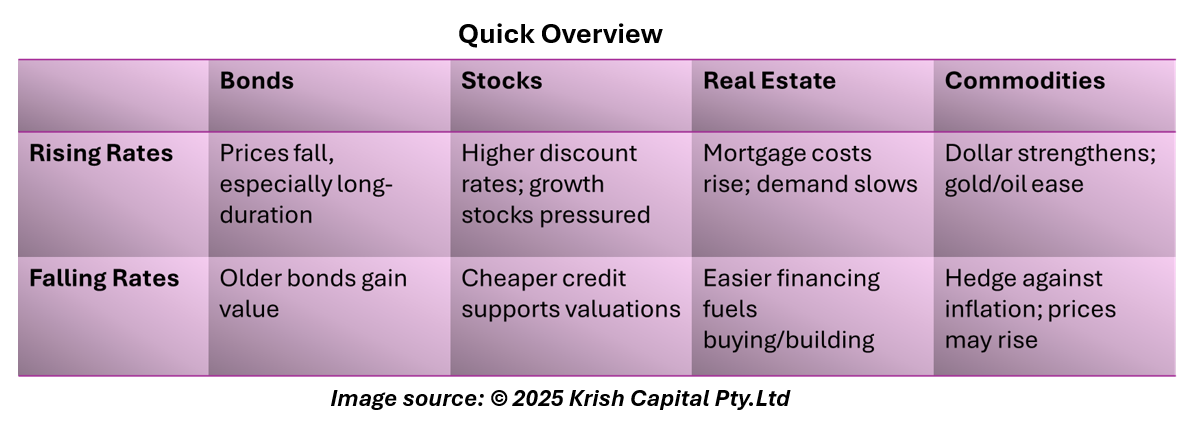
Interest rate changes affect how money moves across bonds, stocks, real estate, and commodities. Higher rates often mean lower asset prices and costlier borrowing, while lower rates can boost demand and valuations. Staying aware of these shifts helps people adjust their investments with greater confidence.


 Oct 16, 2026




 Please wait processing your request...