
 CA
CA
 NZ
NZ
 UK
UK
 AU
AU
 IND
IND

 US
US

 Share
Share
 X (Formerly Twitter)
 Whatsapp
 Facebook
 LinkedIn
 Telegram
 Email This Article
 Copy Link
 Summarize with AI
 Chat GPT
 Perplexity
_09_19_2025_02_29_24_654492.jpg)
Image source: © 2025 Krish Capital Pty.Ltd
Highlights
- Penny stocks are low-priced securities often traded outside major exchanges.
- They typically lack liquidity, reliable financial disclosures, and investor protection.
- The SEC classifies them as high-risk due to fraud potential and limited oversight.
- Investors should use caution, especially in unsolicited promotions or “pump-and-dump” schemes.
According to the Securities and Exchange Commission (SEC), penny stocks are securities from small-scale companies that trade for less than $5 per share and do not appear on major national exchanges. These stocks often attract new investors because of their low cost and the perceived opportunity for large percentage gains. They’re commonly issued by small companies that may not meet the listing standards of national exchanges like the NYSE or Nasdaq, leading them to trade instead over-the-counter (OTC) on platforms like the OTC Bulletin Board or Pink Sheets.
This low barrier to entry gives an illusion of affordability, but the U.S. Securities and Exchange Commission (SEC) stresses that these stocks carry distinct risks, including limited public information and poor liquidity.
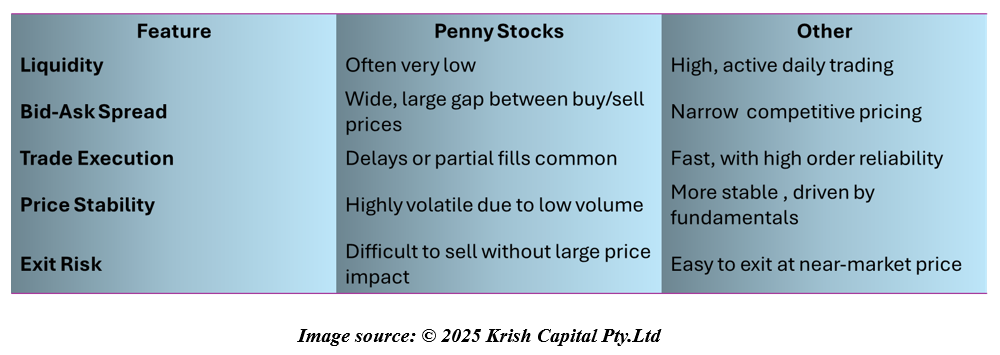
Quick Comparison
Why Transparency Is Often Lacking
Many penny stock issuers are not required to file regular reports with the SEC. As a result, investors often lack the financial statements or business updates needed to evaluate a company's value or viability. The lack of transparent reporting makes it challenging to assess the true financial health of the company, and market prices may be disconnected from actual business performance.
Moreover, smaller firms may not have significant operating history or revenue. This absence of verifiable information increases the risk of manipulation and misrepresentation.
Manipulative Tactics and Fraud Red Flags
Penny stocks are especially prone to fraudulent activity, most notably through pump-and-dump schemes that artificially manipulate market prices. In these schemes, promoters hype up a low-value stock through false or misleading statements, causing a temporary spike in demand and price. After driving up the price, fraudsters offload their shares to the top, often leaving retail investors exposed to sharp losses as the value rapidly collapses.
The SEC urges investors to be wary of unsolicited stock tips received via email, social media, or messaging platforms. High-pressure sales tactics, guaranteed returns, and vague business descriptions are all red flags commonly associated with penny stock fraud.
Liquidity Issues and Exit Risk
Unlike stocks listed on major exchanges, penny stocks often suffer from a lack of buyers and sellers. This means investors may struggle to exit their positions at a fair market price or at all. Even a small trade can result in significant price movements, amplifying volatility and making it difficult to recover invested capital.
Because of the limited market activity, bid-ask spreads can be unusually wide, forcing investors to buy at high prices and sell at low ones. This dynamic further reduces the chances of achieving profitable trade, especially for short-term participants.
SEC's Classification and Investor Protection Rules
The SEC defines a penny stock as a security issued by a very small company that trades below $5 per share and is not listed on a national exchange. To counteract risks, the SEC has implemented rules that require brokers to provide risk disclosures, obtain written agreements from clients before executing trades, and deliver monthly account statements.
These safeguards are designed to ensure that investors understand the speculative nature of such securities before becoming financially exposed. Despite these efforts, the SEC continues to emphasize the importance of personal vigilance when dealing with low-priced or thinly traded stocks.
Penny stocks come with considerable risk. Limited disclosure, high volatility, and potential fraud make them unsuitable for most investors. The SEC’s repeated warnings highlight the need to exercise caution, verify sources, and avoid speculative decisions based on hype or unverified information.


 Oct 16, 2026




 Please wait processing your request...