
 CA
 NZ
 UK
 AU
 IND

 US

 Share
 X (Formerly Twitter)
 Whatsapp
 Facebook
 LinkedIn
 Telegram
 Email This Article
 Copy Link
 Summarize with AI
 Chat GPT
 Perplexity
Key Highlights
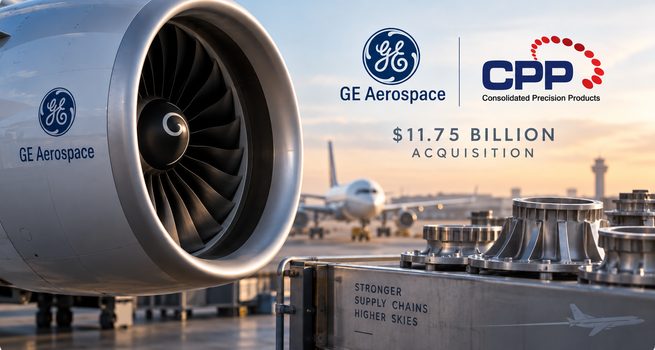
- GE Aerospace to acquire castings supplier Consolidated Precision Products in an $11.75 billion deal, its largest since becoming a standalone company
- Transaction targets a persistent bottleneck in commercial engine Supply chains as Demand for new aircraft and aftermarket repairs continues to outpace capacity
- Deal financed through $7 billion in cash and new debt, with valuation multiples reflecting anticipated synergy benefits
- Move signals a broader industry shift toward vertical integration as manufacturers seek greater control over critical input supply
A Capacity Problem Years in the Making
Commercial aviation's post-pandemic recovery has run into a constraint that has little to do with passenger demand and everything to do with metal. Engine makers have spent several years struggling to convert order backlogs into delivered aircraft and completed repairs, and a persistent culprit has been castings, the complex metal components formed by pouring molten alloy into molds that become turbine blades, vanes and structural parts operating in the hottest sections of a jet engine.
GE Aerospace (NYSE:GE) announced it would acquire Consolidated Precision Products for $11.75 billion, a transaction that moves a critical supplier directly into the company's own operational control rather than leaving it as an external dependency. The scale of the deal, GE Aerospace's largest since its 2024 separation into a standalone aerospace entity, underscores how seriously the company views the castings constraint as a structural risk to its growth trajectory rather than a temporary supply hiccup.
Why Castings Became the Chokepoint
Aircraft engine Manufacturing sits at the intersection of two demand curves that rarely move in tandem. Airlines need more spare parts and repair capacity to keep aging fleets flying, while aircraft manufacturers need new engines to fulfill years-long order books. Both draw on the same narrow supplier base for precision-cast components, and that overlap has strained capacity across the industry regardless of how efficiently any single company operates.
Castings manufacturing is not easily scaled through Capital spending alone. Yield rates, alloy science, and machining precision require accumulated process knowledge that takes years to build. That reality has made castings suppliers unusually valuable and, from an engine maker's perspective, unusually risky to depend on when demand surges simultaneously across commercial, defense and aftermarket channels.
The Logic of Owning the Supply Chain
By bringing CPP in-house, GE Aerospace gains the ability to apply its own operational improvement methodology directly to a Facility network it does not currently control. The company has indicated it expects to lift output through yield improvements, reduced scrap, and better machine utilization rather than through wholesale capacity expansion alone, a strategy that suggests confidence in operational execution as a faster lever than building new plants.
There is also a technology integration argument. Closer coordination between engine design and casting production can compress development timelines for next-generation components, particularly airfoil technology aimed at improving heat tolerance and durability. When design and manufacturing sit inside the same corporate structure, iteration cycles between engineering and production shrink, a dynamic that matters increasingly as engine makers race to deploy more efficient designs.
Financial Structure and Market Reaction
The transaction values CPP at a premium multiple before accounting for expected synergies, a common feature of strategic acquisitions where the acquirer is paying for control and integration potential rather than standalone cash flows alone. The financing mix, weighted toward cash with the remainder in new debt, indicates GE Aerospace is using its improved Balance Sheet position to fund the deal without a dramatic shift in leverage.
Investors appeared to treat the deal as more of a strategic repositioning than an immediate Earnings catalyst, with GE Aerospace shares showing limited movement following the announcement. Shares of Howmet Aerospace (NYSE:HWM), a competing castings producer, fell sharply, reflecting market concern that consolidation of a major customer into a competitor's supply chain could reshape order flow across the broader castings industry. RTX (NYSE:RTX), whose Pratt & Whitney unit also sources components from CPP, declined to comment on the transaction.
A Wider Industry Signal
The Acquisition arrives amid growing commentary from adjacent sectors about supply chain control. Comments from executives at aircraft leasing firms have emphasized that engine availability, not aircraft assembly, remains the binding constraint on fleet growth industry-wide. Separately, interest from outside the traditional aerospace supply base in manufacturing turbine components suggests the pressure point GE Aerospace is addressing extends beyond its own order book and into the broader industrial ecosystem that depends on high-precision metal parts.
For competitors and customers who rely on the same castings supplier base, the deal raises an open question about how consolidation among major buyers will affect capacity allocation for firms not integrated into a single manufacturer's supply chain.
What Comes Next for the Sector
GE Aerospace's acquisition of Consolidated Precision Products represents a structural response to a supply chain constraint that has shaped aerospace manufacturing Economics for several years. Rather than treating castings Scarcity as a problem to be managed through supplier negotiation, the company has opted to internalize the risk and the upside together. Whether this approach delivers the capacity relief the industry needs will depend on execution inside CPP's more than twenty facilities, and on whether rival engine makers respond with similar vertical integration moves of their own. The deal is scheduled to close in the second half of 2027, leaving a multi-year window in which the broader castings supply landscape could shift meaningfully.


 Nov 02, 2026





 Please wait processing your request...