
 CA
 NZ
 UK
 AU
 IND

 US

 Share
 X (Formerly Twitter)
 Whatsapp
 Facebook
 LinkedIn
 Telegram
 Email This Article
 Copy Link
 Summarize with AI
 Chat GPT
 Perplexity
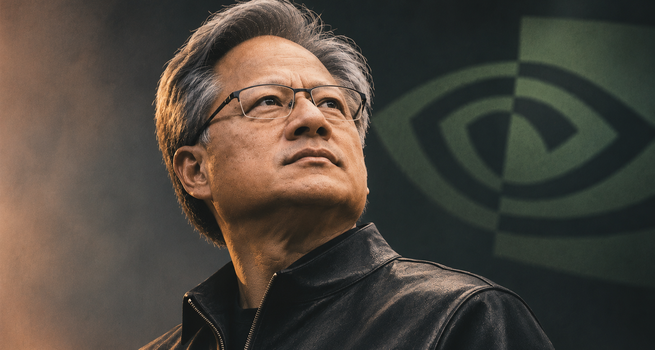
Nvidia's co-founder resigns after a week of revelations. Colette Kress takes over on an interim basis, and the company appoints its first-ever chairman
Few corporate falls have been so swift. A week ago Jensen Huang was the most recognisable figure in the AI boom, running the chipmaker whose processors power much of it. On November 12th Nvidia (NASDAQ:NVDA) announced that he had resigned as president, chief executive and director, effective immediately, ending 33 years at the helm of the company he co-founded in 1993. Colette Kress, the finance chief, becomes interim chief executive. Harvey Jones, a director since 1993, becomes the board's first chairman.
What the company announced
Nvidia's board announced the change in a press release. Its main points were:
- Leadership: Mr Huang has resigned as president, chief executive and member of the board, effective immediately.
- Interim chief: Ms Kress, executive vice-president and chief financial officer, will serve as interim chief executive while keeping her finance role until a permanent successor is named.
- Search: the board is starting a search for a permanent chief executive and will consider internal and external candidates.
- Chairman: Mr Jones, a former chief executive and executive chairman of Synopsys, is appointed the board's first-ever chair.
- Earnings: results for the third quarter of fiscal 2027 will be published as scheduled on Tuesday November 17th, at about 1:20pm Pacific time, with an Earnings call at 2pm.
The release included statements from Mr Jones and Ms Kress, but none from Mr Huang. Mr Jones said:
"The Board has full confidence in Colette and the Leadership team, and we expect the company's operations, customer commitments and product roadmap to continue without interruption."
Ms Kress pledged to build on "the extraordinary foundation Jensen created over the last 33 years", adding:
"Our focus remains on serving our customers, partners, developers and shareholders."
The board thanked Mr Huang for what it called his "immeasurable contributions to the company and the industry".
How it came to this
The crisis unfolded in less than a week.
- Sunday, November 8th: after reports of an affair with Alice Huang, a businesswoman whom American intelligence suspects of spying for China, Mr Huang apologised publicly for being unfaithful to his wife. He gave no details. Ms Huang has worked for Megaspeed, a Chinese company and Nvidia customer. Mr Huang denied compromising national security or company secrets.
- Monday: markets opened to the news. The reports revived concerns that firms in Singapore and Malaysia had evaded American export controls to get Nvidia's technology, and about whether Nvidia knew.
- Tuesday: the board hired Wachtell Lipton, a law firm, to investigate the intelligence allegations.
- Wednesday: the New York Times reported a second affair, with Kimberly Powell, Nvidia's vice-president of health care, and that the board had met to discuss the company's future.
- Thursday: Mr Huang resigned.
The market's verdict
Investors took the news badly. Nvidia's shares fell by as much as 14% after the announcement, and its Market Value dropped below $4trn. The stock is heading for a sixth consecutive weekly decline, its longest losing streak since 2012, and was already down about 7% this year at Wednesday's close. Nvidia has slipped behind Apple in the ranks of the world's most valuable companies.
Analysts had been cutting their forecasts all week. At least ten turned more bearish. Stifel cut its price target from $315 to $205 but kept a buy rating. Baird cut its target from $500 to $200 and downgraded the stock to neutral, citing uncertainty about possible government action.
The damage spread to firms that rely on Nvidia's chips. CoreWeave fell by nearly 12%, IREN by 8% and Nebius by 17%, though Nebius also issued disappointing guidance that day. Rivals gained. AMD's shares have risen by nearly 17% since Monday, and Broadcom rose by more than 5% on Thursday.
Reactions
The response was swift and divided:
- Donald Trump, who had cultivated a close relationship with Mr Huang, praised his record on Truth Social and proposed Tim Cook of Apple as his successor.
- Elizabeth Warren, the Democratic senator expected to chair the Senate Banking Committee, said the resignation does not absolve Mr Huang or Nvidia of responsibility, and called for tighter oversight of chip exports.
- Brian Mast, the Republican chairman of the House Foreign Affairs Committee, said Mr Huang is willing to testify as soon as next week and that a subpoena remains an option.
- Elon Musk, whose SpaceX is among Nvidia's biggest customers, had said before the resignation that it would be an honour to hire Mr Huang. Separately, the White House defended Howard Lutnick, the commerce secretary, after Axios reported that he had repeatedly blocked efforts to crack down on chip smuggling to China.
Who is in charge now
Ms Kress joined Nvidia in September 2013 after finance roles at Texas Instruments, Microsoft and Cisco. In her first fiscal year, Nvidia's Revenue was about $4bn. In fiscal 2026 it was $216bn. She has appeared beside Mr Huang on every quarterly Earnings Call since. Dan Ives of Yorkville Ives & Co. expects her to serve for about a year, with the permanent successor coming from outside.
Mr Jones led Synopsys from 1987, taking it public in 1992, and co-founded Daisy Systems and Tensilica. Analysts have named several internal candidates for the top job, including Ian Buck, Bill Dally, Michael Kagan and Bryan Catanzaro, as well as Ms Kress herself.
What comes next
Three events will shape the coming weeks. The first is the earnings report on November 17th, Ms Kress's first as chief executive. The second is Mr Huang's expected appearance before Congress, possibly within days. The third is the Wachtell Lipton investigation. Together they will decide whether Nvidia's loss is limited to its founder or spreads further.


 Nov 12, 2026





 Please wait processing your request...