
 CA
 NZ
 UK
 AU
 IND

 US

 Share
 X (Formerly Twitter)
 Whatsapp
 Facebook
 LinkedIn
 Telegram
 Email This Article
 Copy Link
 Summarize with AI
 Chat GPT
 Perplexity
Key Highlights
- Warren Buffett steps down as Berkshire Hathaway chairman after 56 years, taking the title of chairman emeritus.
- Howard Buffett becomes chairman while Greg Abel continues as chief executive, splitting operational and cultural authority for the first time.
- Buffett built Berkshire from a failing textile mill into a USD 1.03 trillion conglomerate spanning insurance, rail, energy, and consumer brands.
- Second-quarter results already show Abel actively deploying Berkshire's cash reserves, months ahead of Friday's governance announcement.
- The letter's tone favours forward-looking confidence over retrospective sentiment, consistent with Buffett's long-stated approach to succession.
A Line He Has Used Before
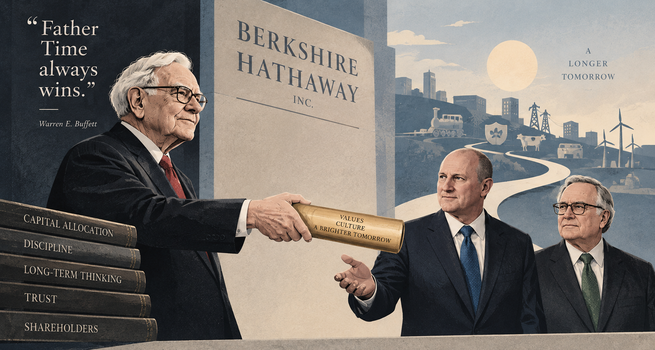
Warren Buffett, the investor long known as the Oracle of Omaha, has stepped down as chairman of Berkshire Hathaway (NYSE:BRK.B), effective immediately. He held the title since 1970, five years after first taking control of the company, and will now serve as chairman emeritus while remaining a director on the board. His son, Howard Buffett, a Berkshire director since 1993, becomes the new chairman.
"Father Time always wins," Buffett wrote in his letter to shareholders on Friday. "He has, however, been generous with me."
The line is not new. Buffett first used it in a Shareholder letter in November 2024, writing about mortality and estate planning. That he reaches for it again now, applying it to his own departure from Berkshire's top seat, is telling in itself. This was not a decision made under pressure. It reads as the next step in a plan Buffett has been narrating to shareholders for close to two years.
Two Roles, One Company
Buffett did not leave the new arrangement open to interpretation. In the same letter, he described exactly how authority would be split at the top:
"Greg runs the company; Howard will guard its culture and values, both worth more than anything on our balance sheet."
Greg Abel, who became chief executive at the start of 2026 after being named Buffett's designated successor in 2021, holds operational control, covering Capital allocation, acquisitions, and the daily running of a conglomerate with dozens of businesses under it. Howard's mandate is narrower and structurally different. He is not there to run the business. He is there to protect what the Business stands for.
Abel used almost identical language in his own statement, saying Berkshire's culture and values "will remain at the heart of Berkshire, and Howard will be their guardian." Two executives, describing the same handoff in nearly the same words, is not a coincidence. It points to a structure worked out well before Friday, not one improvised in response to it.
The Making of an Empire
Buffett took control of Berkshire in 1965, when it was a struggling New England textile manufacturer with little to distinguish it from dozens of others like it. Over the six decades that followed, he built it into a conglomerate now valued at approximately USD 1.03 trillion, spanning GEICO, the BNSF railroad, Berkshire Hathaway Energy, Dairy Queen, Fruit of the Loom, and, more recently, Squishmallows. Few single lists capture Berkshire's sprawl as well as that one, running from a century-old railroad to a plush toy Brand under the same roof.
The number behind that sprawl is one most Market Participants already know by heart: a compounded annual return of approximately 19.7 percent since 1965, nearly double the S&P 500 over the same period. That is not a run of good years. It is six decades of decisions, most of them unremarkable at the time, compounding into a track record that turned Buffett into shorthand for disciplined capital allocation, well beyond the world of professional investing.
The Transition Was Already Under Way
What stands out is that Friday's announcement functions closer to a formality than a turning point. Abel has run Berkshire's operations since January, and the numbers already carry his signature. In the second quarter, Berkshire began drawing down its long-held cash reserves, deploying capital into Equity purchases including Alphabet, alongside billions of dollars in share repurchases. Operating profit rose 16 percent to USD 12.98 billion, ahead of analyst forecasts, while Net Income more than doubled to USD 25.67 billion, aided by unrealised gains on the company's equity holdings.
The capital allocation shift that usually follows a change in Leadership had, in this case, arrived before the leadership change was even made official.
What the Letter Chooses Not to Say
What stands out about Buffett's letter is what it leaves out. There is no extended account of his own career, no attempt to summarise six decades in the language of legacy. The tone leans forward, built around confidence in Abel's operational judgment and trust in Howard's role as cultural steward. Buffett referenced his age directly, noting his recent 96th birthday and a great-grandchild who, he wrote, is "moving a bit faster than I am these days." Even here, at the end of a run few will ever match, he chooses understatement over reflection.
That restraint is not new either. Buffett built his reputation without needing to perform conviction, letting results carry the argument instead. His final letter as chairman does the same. It does not reach for sentiment. It reaches for a plan.
What Comes Next
Berkshire's governance transition is now complete on paper. The more consequential test lies ahead: whether the operational and cultural halves of that structure hold together as Abel deploys record levels of capital without Buffett's direct involvement in decision-making. Berkshire's scale, insurance float, and diversified Earnings base give Abel a wider Margin than most chief executives inherit. Whether that margin is enough to sustain a return profile built over sixty years is not a question Friday's announcement answers. It is one the market will answer gradually, one quarter of capital deployment at a time.

 Oct 20, 2026





 Please wait processing your request...