
 AU
AU
 UK
UK
 CA
CA
 NZ
NZ
 IND
IND

 US
US
Cobalt has emerged as one of the key industrial commodities with the growing popularity of electric vehicles (EVs) powered by lithium-ion batteries. It is estimated that up to 20kg of cobalt is required for EV batteries per car. In addition to the lithium-ion battery segment, cobalt is used in the manufacturing of strong magnets, super alloys, dyes, and pigments.
Cobalt, when mixed with certain metals, forms superalloys, which are used in the manufacturing of jet engines as superalloys retain strength under high pressure and temperature. Cobalt isotopes are used in the medical industry for cancer treatment.
During the mid-twentieth century, cobalt was used in beers as it helped in maintaining a foamy head. The practice stopped due to potential health hazards posed by the combination of alcohol and cobalt.
World Resources of cobalt
The majority of cobalt deposits is found in sediment-hosted stratiform copper deposits of Congo (Kinshasa) and Zambia, nickel-bearing laterite deposits in Australia, and magmatic nickel-copper sulphide deposits hosted in mafic and ultramafic rocks in Canada, Russia, the United States and Australia.
Also, significant resources have been identified in polymetallic nodules and crusts in the Atlantic Ocean, Indian Ocean, and the Pacific Ocean.
Global Production
The Democratic Republic of Congo (DRC) is the world leader in cobalt production. Russia, Australia, and Canada are also significant players, but DRC contributes nearly 31% of the global production (2025).
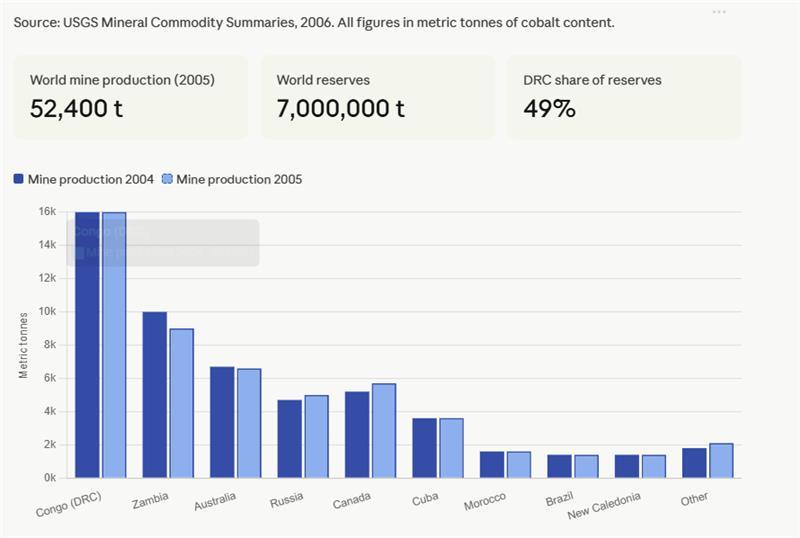
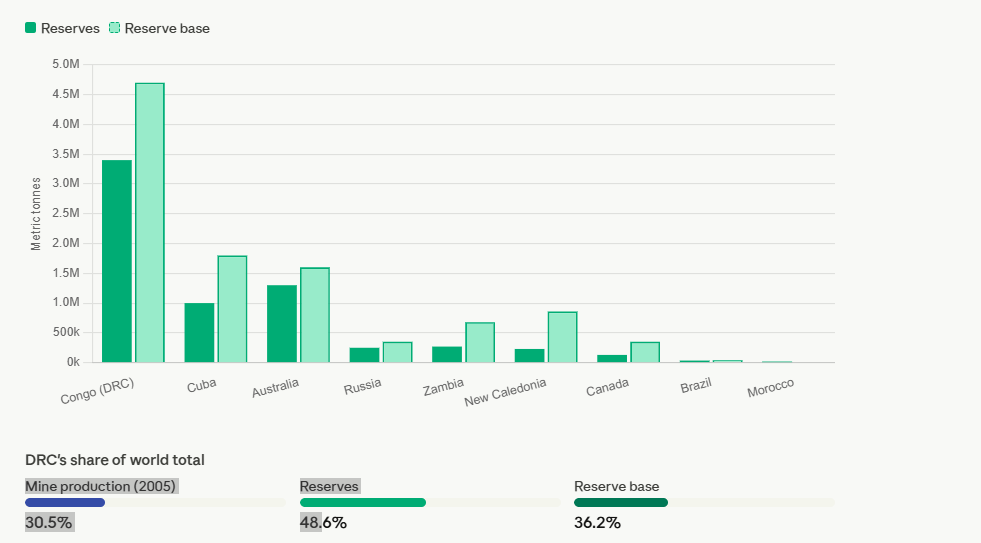
2024-2025 production and reserve data (Data Source: USGS)
The mining industry of DRC has been under scrutiny for several years as reports of unethical and human rights violations keep making the headlines in the African country. A lot of artisanal mining also occurs in the country.
China, which is the global leader in cobalt consumption, uses nearly 80% of the global cobalt supply in the manufacturing process of the rechargeable battery industry.
The information displayed on this page is provided for general informational purposes only and is intended to present factual market data relating to commodities and related listed securities. The information has not been created, researched, analysed, or independently verified by Kalkine. Kalkine does not provide any opinion, recommendation, representation, or advice regarding the merits, suitability, value, performance, prospects, or risks of any commodity displayed on this page.
The information on this website has been provided from a wide variety of sources which Kalkine, to the best of its knowledge and belief, considers accurate. The information does not constitute financial product advice, a recommendation or invitation to buy, sell, hold, subscribe for, or otherwise deal in any financial product. The information does not take into account any person’s investment objectives, financial situation, risk profile, investment experience, tax position, or particular needs and we strongly suggest you seek advice before acting upon any information provided.
To the extent permitted by law, Kalkine Equities LLC excludes all liability for any loss or damage arising from the use of this website and any information published (including any indirect or consequential loss, any data loss or data corruption). If the law prohibits this exclusion, Kalkine Equities LLC hereby limits its liability, to the extent permitted by law to the resupply of services.
Any performance figures, price movements, returns, charts, or information are based on historical or current market data only. Past performance is not a reliable indicator of future performance. Users should not rely on the information on this page for making investment decisions and should seek independent professional advice before acting on any information.
 Please wait processing your request...