
 AU
AU
 UK
UK
 CA
CA
 NZ
NZ
 IND
IND

 US
US

Company Overview: Universal Corporation (NYSE: UVV) is a global business-to-business agriproducts company. The Company is a global leaf tobacco supplier and provides plant-based ingredients to food and beverage end markets. The Company operates through two segments: Tobacco Operations and Ingredients Operations. The Tobacco Operations segment activities involve contracting, procuring, processing, packing, storing, and shipping leaf tobacco for sale to, or for the account of, manufacturers of consumer tobacco products throughout the world.
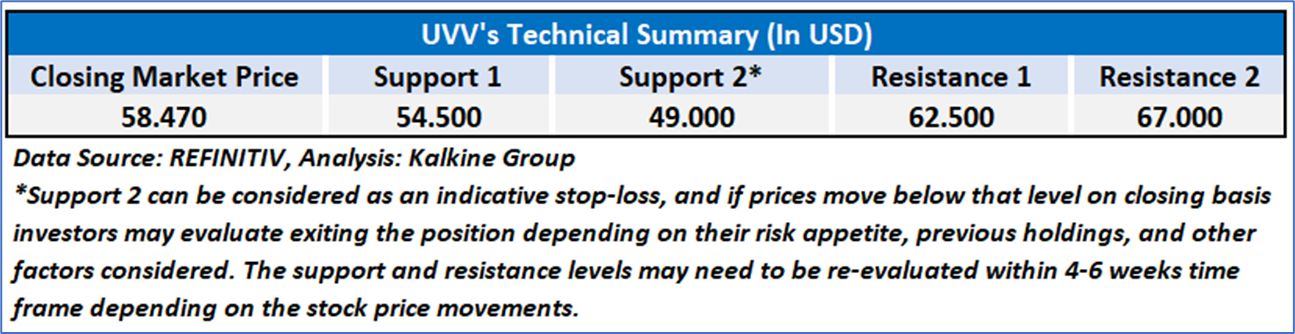
As per our previous Kalkine’s Diversified Opportunities Report published on ‘UVV’ on 08th May 2025, Kalkine provided a ‘Buy’ stance on the stock at USD 58.47, based on “Universal Corporation's (UVV) recent financial and operational achievements, including preliminary Q3 2025 sales and operating revenues of USD 937.2 million, an operating income of USD 100.7 million, strong demand driving a 91.2% revenue contribution from its Tobacco Operations segment, an efficient operating margin of 11.6% in Tobacco Operations, and advancements in its Ingredients Operations with a focus on high-demand value-added products”, giving a return of 11.83%, attaining resistance 1 and resistance 2.
Current Macro and company specific rationales:
Noted below are the details of support and resistance levels provided in our previous report:
Relative Valuation (Price/Earnings based relative valuation):
_06_02_2025_13_53_54_779100.png)
UVV’s Daily Chart
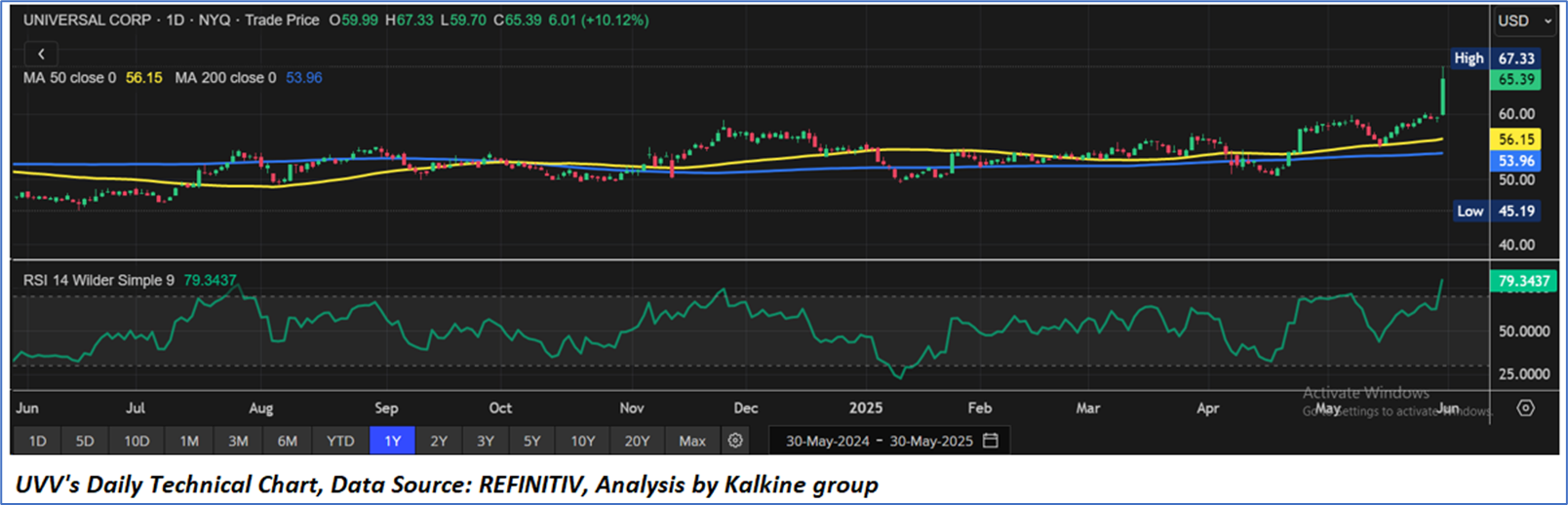
Considering the current trading levels, volatile macro environment, lower intrinsic value as per P/E relative valuation, tariffs uncertainties, resistance 1 and resistance 2 attainment, and risks associated, a ‘Sell’ rating is assigned to the “UVV” at the closing market price of USD 65.39, as of May 30, 2025.
Note: This report may be updated with details around fundamental and technical analysis, price/ chart in due course, as appropriate
Note 1: Past performance is not a reliable indicator of future performance.
Note 2: The reference date for all price data, currency, technical indicators, support, and resistance level is May 30, 2025. The reference data in this report has been partly sourced from REFINITIV.
Note 3: Investment decisions should be made depending on an individual's appetite for upside potential, risks, holding duration, and any previous holdings. An 'Exit' from the stock can be considered if the Target Price mentioned as per the Valuation and or the technical levels provided has been achieved and is subject to the factors discussed above.
Note 4: Target Price refers to a price level that the stock is expected to reach as per the relative valuation method and or technical analysis taking into consideration both short-term and long-term scenarios.
Note 5: ‘Kalkine reports are prepared based on the stock prices captured either from the New York Stock Exchange (NYSE), NASDAQ Capital Markets (NASDAQ), and or REFINITIV. Typically, all sources (NYSE, NASDAQ, or REFINITIV) may reflect stock prices with a delay which could be a lag of 15-20 minutes. There can be no assurance that future results or events will be consistent with the information provided in the report. The information is subject to change without any prior notice.’
Kalkine Equities LLC, with Delaware File Number 4697384, Foreign Qualification Registration in California File Number 202109211078, and Texas File Number 805521396, is authorized to provide general advice only. The information on https://kalkine.com/ does not take into account any of your investment objectives, financial situation or needs. You should consider the appropriateness of advice taking into account your own objectives, financial situation and needs and seek independent financial advice before making any financial decisions. The link to our Terms and Conditions and Privacy Policy has been provided for your reference. On the date of publishing the reports (mentioned on the website), employees and/or associates of Kalkine do not hold positions in any of the stocks covered on the website. These stocks can change any time and readers of the reports should not consider these stocks as advice or recommendations later.
Past performance is not a reliable indicator of future performance.
 Please wait processing your request...